How to Brine a Turkey in a Bag: Safe Ratios, Bag Setup & Time Chart
⚖️ Calculate Exact Salt by Water Volume
Never guess tablespoons. Switch between Diamond Crystal Kosher, Morton, or Fine Sea Salt in our interactive brine calculator to get exact gram weights for your water volume:
Open Turkey Brine Calculator →When November arrives, home cooks inevitably face the logistics nightmare of wet brining a 16-to-20-pound whole turkey. Attempting to submerge a massive bird inside a rigid stockpot or bucket requires upwards of 4 to 5 gallons of liquid, creating a 50-pound sloshing hazard that commandeers entire refrigerator shelves and risks catastrophic raw poultry spills.
Using a dedicated food-grade culinary brining bag solves the volumetric problem through fluid dynamics. Because a flexible bag conforms tightly to the contour of the turkey, you can displace trapped air and achieve total, 360-degree submerged contact using just 1.5 to 2 gallons of brine. Less water means less wasted salt, faster chilling, and effortless refrigerator storage.
The Critical Safety Rule: Food-Grade vs. Trash Bags
Every holiday season, well-meaning food blogs recommend lining a five-gallon bucket with an ordinary black plastic trash bag. Never do this under any circumstances.
- Recycled Resins & Slip Agents: Trash bags are fabricated from non-food-grade recycled polymers and coated with industrial slip agents and oleamides to make bags slide off rolls smoothly.
- Chemical Fragrances & Biocides: Most trash bags contain heavy artificial deodorizers or antimicrobial biocides (like zinc pyrithione). In a salty, acidic environment over 24 hours, these compounds leach directly into poultry muscle fibers.
- FDA Standards: Only use bags clearly labeled as BPA-Free, FDA-compliant Food Contact Safe, or heavy-duty food vacuum seal rolls. Brands like Ziploc XL/XXL Big Bags or dedicated Turkey Brining Bags from culinary supply stores are certified safe.
Salt Density Matrix: Diamond Crystal vs. Morton
The most frequent cause of an over-salty holiday turkey is measuring salt by volume rather than mass. Different kosher salts possess radically different crystal structures and bulk densities:
| Salt Brand / Type | Weight per Cup | Volume for 2 Gallons (6% Brine) | Salinity Precision |
|---|---|---|---|
| Diamond Crystal Kosher Salt | 140g per cup | 3.5 Cups (~490g total) | Fluffy hollow flakes; dissolves effortlessly; gentle margin of error |
| Morton Kosher Salt | 240g per cup | 2.0 Cups (~480g total) | Dense flat flakes; 1.7x denser than Diamond Crystal! |
| Fine Table Salt / Sea Salt | 280g per cup | 1.75 Cups (~490g total) | Ultra-dense cubic granules; risk of over-salting if measured by volume |
The Air Displacement & Secondary Containment Technique
Follow this 5-step protocol to prevent puncture disasters and ensure uniform brine distribution:
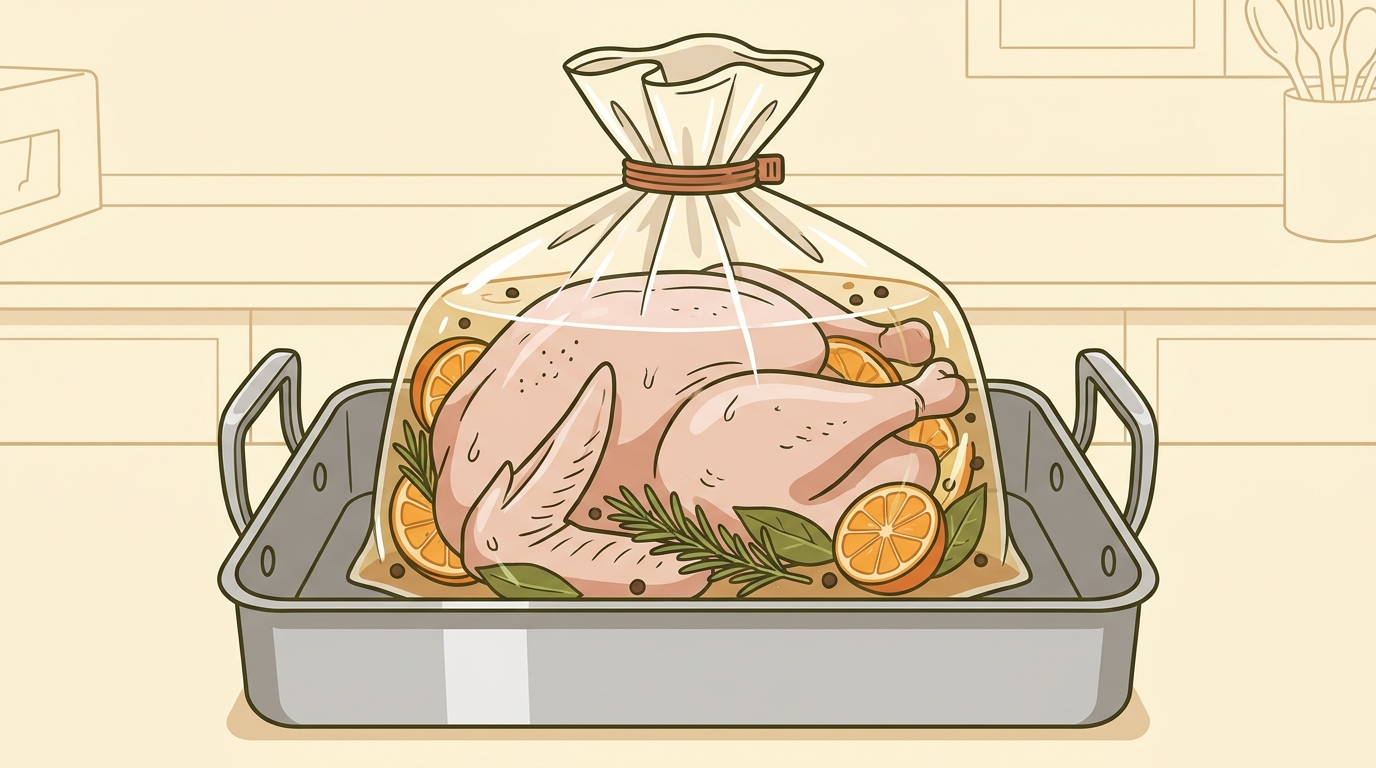
- The Secondary Containment Rule: Never trust a single bag alone on a refrigerator shelf. Always place the brining bag inside a sturdy stainless steel roasting pan or deep stockpot before loading the bird. If the bag is accidentally nicked by a bone or claw, the pan catches the liquid.
- Load Breast-Side Down: Lower the bird into the bag with the breast facing toward the bottom. The breast meat is the thickest and most prone to dryness, so keeping it submerged at the lowest point guarantees maximum osmotic uptake.
- Pour Completely Chilled Brine: Never pour warm brine over raw poultry! Dissolve your salt in 2 quarts of hot water, then temper with 6 quarts of ice water until the entire solution registers under 40°F (4°C) before pouring.
- Displace Trapped Air: Gather the neck of the bag tightly with your hands and gently press the sides inward until the liquid rises to the brim, forcing out all air bubbles. Twist the top securely and fasten with a heavy zip-tie.
- The Cooler Alternative: If your refrigerator lacks clearance for a roasting pan, place the bagged turkey inside an insulated camping cooler. Pack 10 pounds of ice around the exterior of the bag. Keep a probe thermometer inside the cooler to confirm the ambient temperature stays under 38°F (3°C) throughout the brine.
Brining Duration Matrix by Turkey Weight
| Turkey Weight (lbs) | Optimal Wet Brine Duration | Post-Brine Air Dry (Fridge) | Total Prep Window |
|---|---|---|---|
| 8 to 12 lbs (Bone-in Breast / Small) | 8 to 12 Hours | 12 Hours (Uncovered) | 24 Hours |
| 14 to 18 lbs (Standard Whole Bird) | 14 to 18 Hours | 18 to 24 Hours | 36 to 42 Hours |
| 20 to 24 lbs (Large Whole Bird) | 20 to 24 Hours (Maximum) | 24 Hours | 48 Hours |
Note: Never exceed 24 hours of wet brining for whole poultry. After 24 hours in a saline bath, muscle fibers begin to denature excessively, causing the cooked meat texture to turn mushy and spongy rather than succulent.
Frequently Asked Questions (People Also Ask)
What if my store-bought turkey is already injected with a sodium solution?
Check the fine print on the label. If the packaging states "contains up to an 8% to 15% solution of broth, salt, and seasonings" (standard in Butterball or supermarket frozen birds), do not wet brine! Double-brining an injected bird will result in aggressively salty, inedible meat. For injected birds, follow our guide to handling pre-brined turkeys.
How do I get crispy skin after wet brining in a bag?
Wet brining saturates poultry skin with water. If you transfer the bird directly from the brining bag into a hot oven, the trapped skin moisture will steam instead of crisping, leaving rubbery skin. You must pat the skin completely dry and let it rest uncovered on a wire rack inside the refrigerator for 12 to 24 hours before roasting to form a dry pellicle.
Is dry brining better than wet brining in a bag?
Both methods have distinct scientific advantages. Wet brining plumps lean breast meat with up to 10% added water weight, making it extremely forgiving against overcooking. Dry brining (rubbing salt directly onto skin) seasons the meat without diluting beef or poultry flavor, yielding superior skin crispness. Read our head-to-head comparison in Dry Brine vs Wet Brine.