Dry Brine Prime Rib: Salt Ratios, Rest Times & Crust Science Guide
⚖️ Calculate Equilibrium Salt for Beef Roasts
Prime rib is an expensive centerpiece. Use our precision calculator to compute exact dry salt grams per pound or compare against poultry brining formulas:
Open Precision Brine Calculator →A prime rib (standing rib roast) is the undisputed king of celebratory holiday centerpieces. Yet millions of home cooks make the catastrophic error of seasoning their prime rib just 15 minutes before sliding it into the oven. The result? A roast that is aggressively salty on the very outer quarter-inch, but bland, gray, and unseasoned throughout the interior.
Dry brining (often called salting in advance) is the single most transformative culinary technique for large cuts of beef. By salting your prime rib 24 to 48 hours prior to cooking and resting it uncovered in the refrigerator, you harness the power of natural cellular osmosis to season the meat all the way to the bone while dehydrating the exterior for a restaurant-grade, crackling crust.
The Molecular Science: How Dry Salting Penetrates Meat
Many home cooks mistakenly believe that salt "dries out" meat because they observe moisture beading on the surface after 15 minutes. In reality, dry brining is a sophisticated three-stage biochemical process:
- Stage 1: Osmotic Draw (Minutes 0–30): Coarse salt crystals sprinkled onto raw beef create a hypertonic surface environment. Water is drawn out of the muscle cells via osmosis, forming beads of clear liquid that dissolve the salt crystals into a concentrated surface brine.
- Stage 2: Protein Denaturation & Reabsorption (Hours 1–12): As the dissolved salt sits on the meat, sodium ($Na^+$) and chloride ($Cl^-$) ions begin to diffuse back into the muscle tissue. The salt ions break cross-linked bonds between myosin and actin muscle filaments. As these protein filaments uncoil and relax, they gain the capacity to trap and hold onto water during cooking.
- Stage 3: Deep Diffusion & Pellicle Formation (Hours 12–48): The dissolved brine is fully drawn back into the interior of the roast. Simultaneously, the dry circulating air of the refrigerator evaporates lingering moisture from the surface fat cap, creating a dry, taut skin called a pellicle.
🥩 Why Wet Brining Destroys High-End Beef:
While lean turkey and pork benefit from wet brines that add 10% water weight, you must never wet brine a prime rib. Submerging high-grade marbled beef in water dilutes concentrated beef umami, creates a spongy, water-logged texture, and makes achieving a deep Maillard crust virtually impossible.
Salt Ratios: The Gram-Accuracy Formula
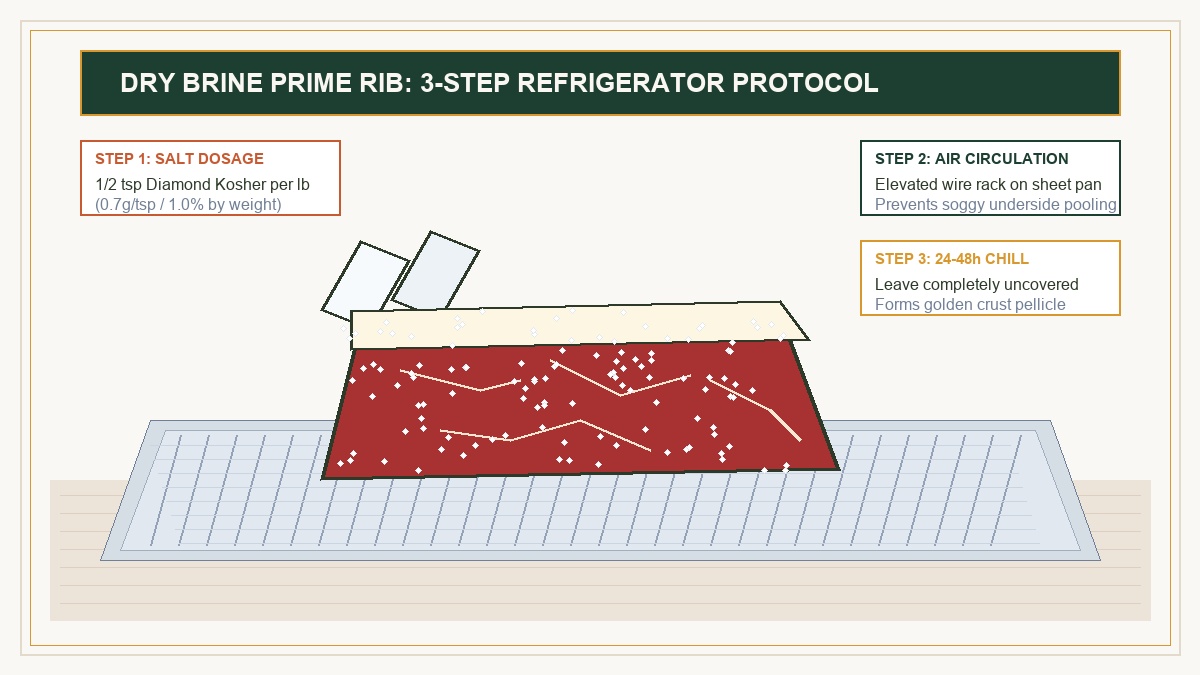
Because prime rib has significant fat and bone weight, precision is vital. The culinary sweet spot for dry brining beef is 1.0% to 1.25% pure salt by meat weight:
| Roast Size (Bone-in) | Diamond Crystal Kosher | Morton Kosher Salt | Exact Gram Weight (1.0%) |
|---|---|---|---|
| 5 to 6 lbs (2 Bones, 4-6 Servings) | 2.5 to 3.0 Level Teaspoons | 1.5 to 1.75 Level Teaspoons | 23g to 27g |
| 8 to 10 lbs (3 Bones, 8-10 Servings) | 4.0 to 5.0 Level Teaspoons (~1.5 Tbsp) | 2.5 to 3.0 Level Teaspoons | 36g to 45g |
| 12 to 14 lbs (4 Bones, 12-14 Servings) | 6.0 to 7.0 Level Teaspoons (~2.25 Tbsp) | 3.5 to 4.25 Level Teaspoons | 54g to 63g |
The Refrigerator Aging Protocol (24 vs. 48 Hours)
- 24 Hours: Good minimum standard. Salt has penetrated approximately 1/2 to 3/4 inch into the muscle. The surface is dry to the touch.
- 48 Hours (The Gold Standard): Optimal flavor and crust balance. Salt has diffused fully toward the center bones. The exterior fat cap turns a deep translucent burgundy and feels like dry parchment paper.
- 72+ Hours: Excessive for standard roasts. The exterior can begin to oxidize and take on a cured, bresaola-like rim. Reserve 72-hour aging only for massive 7-bone full rib racks.
The Reverse Sear Roasting Schedule
To capitalize on your 48-hour dry brine, roast using the Reverse Sear method:
- Low & Slow Phase (225°F / 107°C): Place the cold, dry-brined roast on a wire rack inside a roasting pan. Roast slowly at 225°F until a digital meat probe inserted into the center reads 118°F to 120°F (48°C) for medium-rare (roughly 35 to 40 minutes per pound).
- The Tent Rest (30 to 45 Minutes): Remove roast from the oven and tent loosely with foil. During this rest, carryover cooking will raise the core temperature to ~128°F, and muscle juices will redistribute throughout the fibers.
- The 500°F Blast Finish: Crank your oven to 500°F (or highest broil setting). Remove foil and slide the roast back in for 8 to 10 minutes. Because the dry brine eliminated all surface water, the Maillard reaction occurs instantaneously, exploding into a dark mahogany crust without overcooking the pink interior!
Frequently Asked Questions (People Also Ask)
Can I add pepper and herbs during the dry brine?
Only salt can penetrate muscle tissue at a cellular level. Black pepper, garlic powder, and herbs consist of large organic molecules that cannot pass through cell membranes; they remain stuck on the surface. You can add finely cracked pepper and minced rosemary during the dry brine if desired, but salt is the only active chemical agent driving osmosis.
What is the difference between dry brining and curing with Prague powder?
Dry brining prime rib uses pure non-iodized sodium chloride (table/kosher salt) strictly for culinary seasoning and juiciness over 24-48 hours. Meat curing (such as corned beef, pastrami, or bacon) uses Prague Powder #1 (sodium nitrite) to chemically inhibit botulism spores and fix pink color over 7 to 14 days. Never use curing salt on a fresh prime rib roast.
Does dry brining work on boneless rib roasts?
Yes! In fact, dry brining is even more effective on boneless rib roasts because salt can be applied directly to all four sides of the meat rather than being blocked by rib bones. Reduce salt volume by approximately 15% to account for the absence of bone mass.