Equilibrium Curing vs. Salt Box Method: Precision Charcuterie Math
⚖️ Compute Exact Equilibrium Cure Formulations
Input your meat weight into our interactive curing calculator to instantly generate exact gram weights for salt, sugar, and Prague Powder #1 or #2:
Open Curing Salt Calculator →If you read historical butcher manuals or old farmhouse cookbooks, the instructions for curing bacon or ham almost universally follow the Salt Box Method: "Dredge the meat thoroughly in a wooden box of salt, leave for two days per pound, wash, and hang to dry."
While this crude method allowed our ancestors to survive long winters before the invention of mechanical refrigeration, it is fundamentally flawed for modern culinary standards. It relies on a high-stakes race against the clock: pull the meat out 24 hours too early, and the core remains raw and susceptible to lethal botulism; pull it out 24 hours too late, and the meat becomes an unpalatable salt lick requiring hours of soaking in tap water.
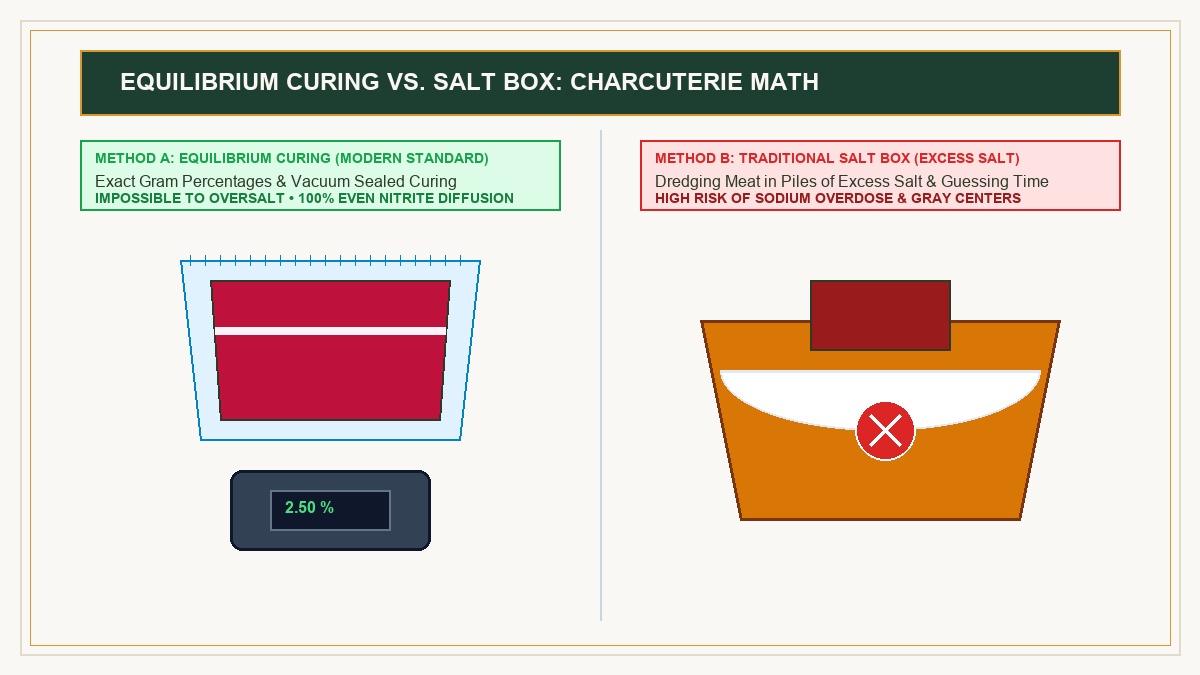
Modern artisan charcutiers have abandoned this guesswork in favor of Equilibrium Curing (EQ Curing). By applying basic principles of diffusion kinetics and digital scale accuracy, equilibrium curing guarantees 100% predictable, restaurant-grade results every single time.
Head-to-Head Comparison: Equilibrium vs. Salt Box
| Parameter | Equilibrium Curing (EQ Method) | Traditional Salt Box Method |
|---|---|---|
| Measurement Precision | 100% Gram Scale Accuracy: Exact % of meat mass | Volume guess / Dredging in open salt mounds |
| Risk of Over-Salting | Zero: Mathematically impossible to over-salt | Very High: Leaves meat aggressively salty |
| Timing Margin of Error | Forgiving: Can leave in bag days/weeks longer | Crucial: Pulling late ruins the meat |
| Post-Cure Water Soaking | NEVER Needed: Perfect salinity out of bag | Always required to leach out excess salt |
| Nitrite Distribution | Uniform 156 PPM throughout entire muscle | Spike near surface; potential gray core |
| Vessel / Packaging | Vacuum-sealed food-grade plastic or zip bag | Open crock, wooden box, or non-reactive tray |
The Diffusion Physics: Fick's Second Law
Why does equilibrium curing eliminate the risk of over-salting? The answer lies in Fick’s Second Law of Diffusion, which states that solute molecules (sodium and nitrite ions) naturally migrate from an area of higher concentration to an area of lower concentration until uniform concentration is reached.
In the Salt Box Method, the concentration outside the meat is virtually infinite (pure salt). The meat acts like a sponge, absorbing more and more salt ions as time passes. If left indefinitely, the meat will reach 15% to 20% salinity—inedible and hazardous.
In Equilibrium Curing, you measure exactly 2.5% total salt relative to the meat's mass. When sealed inside a vacuum bag, the salt dissolves in the meat's surface moisture, diffuses inward through muscle fibers, and once the internal salinity reaches exactly 2.5%, the chemical gradient drops to zero. Diffusion ceases. The cure stops itself.
The Master Equilibrium Mathematical Formula
To formulate any equilibrium cure for pork belly (bacon), beef brisket (pastrami/corned beef), or duck prosciutto, follow this standard three-component matrix:
📐 The Standard EQ Charcuterie Formula:
- Total Meat Mass ($M$): Weighed on a gram scale (e.g., $2,000 ext{g}$ pork belly).
- Target Salinity: $2.25\%$ to $2.50\%$ of meat mass.
- Prague Powder #1 or #2: Exactly $0.25\%$ ($2.5 ext{g}$ per $1,000 ext{g}$ of meat). This guarantees exactly 156 PPM of sodium nitrite adhering to USDA FSIS regulations.
- Pure Non-Iodized Salt: $ ext{Target Salinity} - 0.23\%$ (offsetting the 93.75% table salt carrier inside Prague Powder).
- Sugar (Optional): $0.75\%$ to $1.25\%$ brown sugar or maple sugar.
Step-by-Step Vacuum Bag Execution Protocol
- Weigh Clean Meat: Trim unwanted cartilage or ragged edges. Record exact mass in grams.
- Combine Dry Ingredients: Calculate pure sea salt, curing salt (Prague #1 for bacon, #2 for dry salumi), sugar, and cracked spices into a small bowl. Stir until homogeneous.
- Rub 100% of the Cure: Sprinkle the cure onto the meat over a rimmed baking sheet. Rub into every crevice, fold, and corner. Use your fingers to scrape every last milligram of cure from the bowl onto the meat.
- Vacuum Seal: Slide the seasoned meat into a heavy-duty food vacuum bag. Vacuum seal and heat-crimp closed. If any liquid or salt crystals remain on the tray, scrape them into the bag before sealing.
- Cold Refrigerator Diffusion: Place the sealed bag into your refrigerator at 36°F–38°F (2°C–3°C). Flip the bag once daily to redistribute extracted brine. Allow 7 to 10 days for pork belly up to 2 inches thick, or 12 to 14 days for thick beef briskets or pork loins.
- Rinse and Dry: Slit the bag open. Rinse surface spices under cold water for 15 seconds. Pat bone-dry. Your meat is now perfectly seasoned from perimeter to core with zero guesswork, zero gray bands, and zero need for soaking baths!
Frequently Asked Questions (People Also Ask)
What happens if I don't have a vacuum sealer?
A vacuum sealer is convenient but not mandatory! You can use heavy-duty Ziploc freezer bags. Place the meat and 100% of the cure into the bag, submerge the bag in a sink full of water up to the zipper to expel trapped air (the water displacement method), and zip closed. The key requirement is tight plastic contact against meat.
Can I equilibrium cure meat that has bones in it?
Yes, but you should adjust the weight calculation. Dense bone marrow does not absorb salt at the same rate as muscle tissue. When equilibrium curing bone-in cuts (such as bone-in pork shoulder or standing rib roasts), estimate and subtract the bone weight (typically 15% to 20% of total mass) before calculating your salt percentage.
Why does equilibrium curing produce a better smoke flavor?
In traditional salt box curing, meat must be soaked in freshwater for hours to remove surface salt. This water-soaking saturates the outer 1/4-inch of meat with moisture. In equilibrium curing, no soaking is needed; the meat surface dries rapidly into a sticky pellicle in the refrigerator, which bonds avidly with vaporized wood smoke phenols during cold smoking. Read more in our homemade bacon curing guide.