Fermentation Crocks vs. Mason Jars: Airlock Science & Vessel Guide
⚖️ Scale Salt for Any Vessel Capacity
Whether filling a 1-quart Mason jar or a 10-liter Ohio stoneware crock, salt precision is paramount. Use our calculator to compute exact grams for vegetable weight or water brines:
Open Fermentation Calculator →Every home fermenter eventually arrives at the vessel crossroads: should you invest in an authentic, heavy German-style water-channel stoneware crock, or should you stick to the ubiquitous wide-mouth glass Mason jars found in every American pantry?
This decision is not merely an aesthetic choice between rustic farmhouse stoneware and modern glass. It involves distinct principles of thermodynamics, photobiology, and gas-exchange mechanics. Choosing the wrong vessel for your kitchen environment can mean the difference between crisp, effervescent sauerkraut and a mushy, yeast-contaminated disappointment.
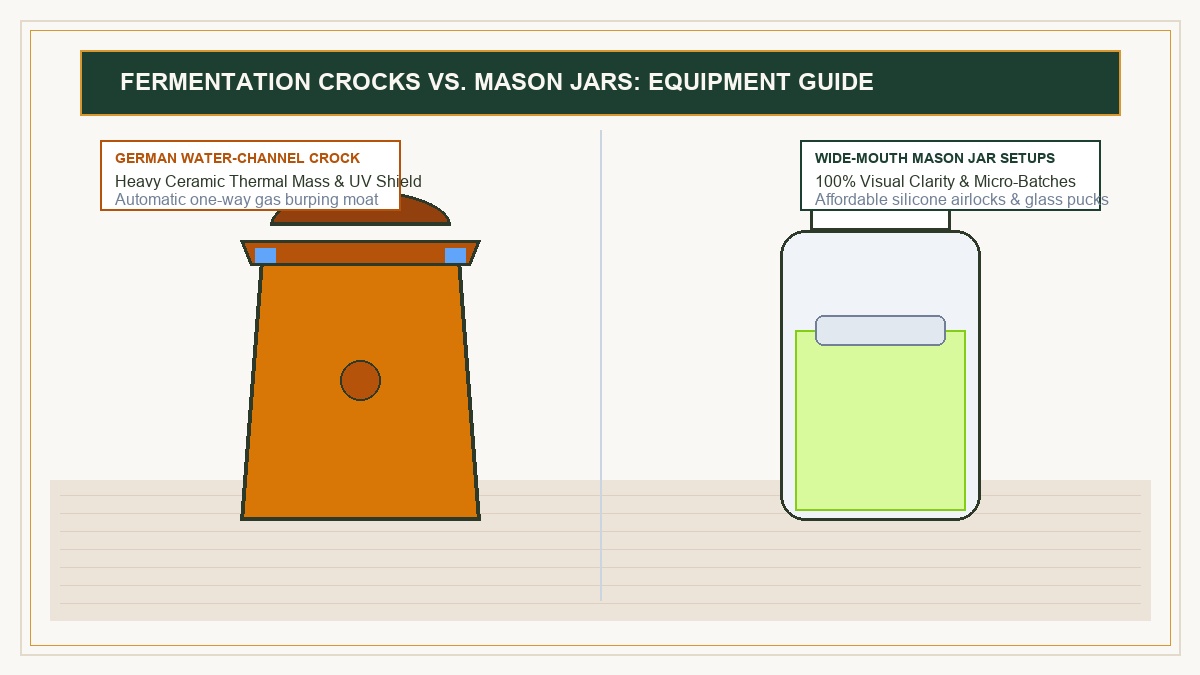
Head-to-Head Comparison: Ceramic Crock vs. Glass Jar
| Performance Metric | Water-Channel Stoneware Crock | Wide-Mouth Glass Mason Jar |
|---|---|---|
| Ideal Batch Capacity | High volume: 5 to 20 Liters (10–35 lbs cabbage) | Small batch: 1 Quart to 1/2 Gallon (2–5 lbs) |
| Thermal Buffering | Superior: Thick clay walls absorb heat spikes | Low: Fluctuates rapidly with kitchen air |
| UV / Light Protection | 100% Opaque: Complete photon blockage | Zero: Requires dark cupboard or cloth wrap |
| Airlock Mechanism | Continuous self-sealing water moat (zero burping) | Silicone nipple valve or 3-piece plastic airlock |
| Visual Monitoring | Blind (cannot see inside without lifting lid) | 100% Transparent: Instant bubble tracking |
| Weight / Storage | Heavy (15–25 lbs empty); dedicated counter space | Lightweight; fits standard refrigerator doors |
| Entry Cost | \$70 to \$180 (Investment heirloom piece) | \$3 to \$12 (Accessible, modular hardware) |
The Physics of the Water-Channel Moat
The defining engineering breakthrough of the European pickling crock is the gutter water-channel. Around the upper rim of the crock is a deep circular moat filled with clean water. The heavy ceramic lid sits directly inside this trough of liquid.
This creates a completely mechanical, frictionless one-way check valve:
- Outward Pressure Release: As active Leuconostoc mesenteroides produce carbon dioxide gas during the first 72 hours, internal atmospheric pressure rises. When internal pressure exceeds the shallow water weight, the lid momentarily lifts fractionally, releasing gas bubbles through the water moat with a satisfying "bloop".
- Inward Oxygen Blockade: The moment pressure equalizes, gravity pulls the lid back down into the water. Ambient oxygen, airborne mold spores, and fruit flies (Drosophila melanogaster) cannot swim through the water barrier to colonize the brine.
🌡️ The Thermal Mass Advantage:
Lactic acid bacteria produce the cleanest, crispiest texture between 65°F and 72°F (18°C–22°C). In homes without central air conditioning, daytime temperatures can surge into the 80s. A 15-pound ceramic crock has immense thermal inertia, smoothing out daily temperature spikes that would otherwise cause vegetable pectin to degrade into mush in thin glass jars.
Why Mason Jars Excel for Beginners & Hot Sauces
Despite the grandeur of stoneware, Mason jars hold a commanding advantage in modern artisan kitchens for small experiments:
- Zero Guesswork: With a glass jar, you can visibly inspect brine clarity, monitor rising CO2 micro-bubbles, and spot floaters instantly without breaking the anaerobic seal.
- Batch Isolation: If you are testing innovative recipes—such as fermented garlic honey or fermented habanero hot sauce—fermenting in multiple 1-quart jars prevents a single contaminated cabbage head from ruining a 5-gallon seasonal harvest.
- Seamless Cold Storage: When fermentation concludes, you do not need to scoop produce into separate storage containers. Simply remove the silicone airlock, screw on a solid storage lid, and transfer the jar directly into your kitchen refrigerator.
Stoneware Weights vs. Glass Puck Weights
Regardless of which vessel you choose, vegetables must remain completely submerged beneath the brine surface. Here is how weight systems compare:
- Unglazed Ceramic Stone Weights (Split Semi-Circles): Traditional crocks include two unglazed semi-circular clay stones. Warning: Porous unglazed stones can absorb brine and harbor mold spores over years of use. Boil unglazed stones for 20 minutes before each season, or upgrade to glazed stones.
- Heavy Lead-Free Glass Pucks: Modern glass pucks for Mason jars are completely non-porous, dishwasher safe, and will never harbor microbial bacteria or absorb garlic odors.
Frequently Asked Questions (People Also Ask)
Can vintage antique crocks contain lead in their glaze?
Yes! Antique stoneware crocks made prior to the 1970s frequently used lead and cadmium in their ceramic glazes to achieve low firing temperatures. When exposed to acidic fermentation brine (pH 3.5) for weeks, toxic heavy metals leach into food. Never ferment in antique vintage crocks unless certified lead-free with a lab test kit. Stick to modern manufacturers like Ohio Stoneware or Schmitt.
Do silicone "pickle pipe" airlocks really work on Mason jars?
Yes, silicone valves work through elastic tension. A microscopic slit at the peak of the silicone dome opens under internal gas pressure to vent carbon dioxide, then snaps closed to bar outside oxygen. They are virtually indestructible and do not require water monitoring.
What size crock should I buy for a beginner?
A 5-liter (1.3-gallon) crock is the sweet spot. It comfortably holds 8 to 10 pounds of shredded cabbage (roughly 4 medium heads)—the perfect yield for a family to enjoy over winter without dominating entire kitchen counter footprints.