Sourdough Discard Bagels: Authentic Chewy NY-Style Baker's Guide
⚖️ Calculate Stiff Hydration with Baker's Math
Authentic bagels require an exceptionally stiff 54% to 58% hydration dough. Use our interactive calculator to compute exact flour, water, and discard offsets for your batch size:
Open Sourdough Hydration Calculator →Most home sourdough recipes focus on high-hydration artisan boules with airy, open crumb structures (75% to 85% water). But when it comes to an authentic New York bagel, open airy bread is the ultimate failure. A true bagel demands a dense, toothsome, intensely chewy crumb enclosed within a thin, glossy, micro-blistered crust that snaps when bitten into.
Using sourdough discard (unfed starter accumulated in the refrigerator) is not just a clever zero-waste kitchen strategy; it is chemically ideal for bagel dough. Sourdough discard introduces broken-down gluten enzymes, organic lactic acids, and aromatic esters that tenderize the dense dough just enough to produce a chewy rather than rubbery bite, while infusing old-world bakery complexity.
Baker's Percentages: Stiff Dough Formulation
In professional baking math, all ingredients are calculated as a percentage relative to the Total Flour Weight (100%). Because standard 100% hydration discard consists of equal parts flour and water by weight (e.g., 100g discard = 50g flour + 50g water), you must account for that moisture when measuring your mixing water:
| Component | Baker's % | Standard Batch (8 Bagels) | Role in Finished Crumb |
|---|---|---|---|
| High-Gluten Bread Flour | 100.0% | 500g (Total Flour) | 12.7%–14% protein for robust gluten matrix |
| Water (Filtered, Cool) | 56.0% | 230g (Offset for Discard) | Stiff hydration prevents dough collapsing |
| Sourdough Discard (100% Hydr.) | 20.0% | 100g (50g flour + 50g water) | Organic acid complexity & extensibility |
| Non-Diastatic Barley Malt | 3.0% | 15g (or honey) | Food for yeast & classic malted aroma |
| Fine Sea Salt | 2.0% | 10g | Tightens gluten bonds & regulates rise |
| Instant Yeast (Optional Boost) | 0.6% | 3g | Guarantees reliable lift with acidic discard |
The Science of the Alkaline Boiling Water Bath
The defining technical step that separates a boiled bagel from a round roll with a hole in the middle is the water bath poaching step. When cold-fermented dough rings are dropped into boiling water, three rapid physical reactions occur simultaneously:
- Starch Gelatinization: Starches on the dough exterior absorb water and swell at 140°F–150°F (60°C–65°C), fusing into a gelatinized skin. This semi-permeable exterior barrier locks in the internal carbon dioxide bubbles, keeping the crumb tight and dense during the subsequent oven bake.
- Yeast Inactivation at the Perimeter: The boiling heat instantly kills surface yeast cells, halting surface expansion while internal yeast cells remain alive to deliver a small, controlled oven burst.
- Malt Caramelization Pre-Seeding: Dissolving 2 tablespoons of non-diastatic barley malt syrup (or 1 tablespoon of baking soda for extra alkalinity) into the 4-quart boiling bath lowers the surface pH and deposits reducing sugars directly onto the skin. Under 425°F oven heat, these sugars undergo aggressive Maillard browning, creating the unmistakable dark golden sheen and micro-blisters.
⏱️ Boiling Duration Rule:
45 seconds per side: Classic chewy crust with excellent oven spring.
60 to 90 seconds per side: Ultra-heavy, dense Montreal/Old-World chew. Never boil beyond 90 seconds per side, as the crust will become unpleasantly leathery and prevent internal baking.
Step-by-Step Production Protocol
For best results, execute this schedule over 24 hours to maximize flavor through an overnight refrigerator cold retard:
- Knead to Windowpane: Combine ingredients in a stand mixer fitted with a dough hook on low speed for 10 to 12 minutes. Because 56% hydration dough is very stiff, avoid overheating your mixer motor. The finished dough must be completely smooth, satin-like, and non-sticky.
- Short Bulk Rest: Allow the dough to rest in a covered bowl for 60 to 90 minutes at room temperature (70°F–74°F). Unlike an artisan loaf undergoing long bulk fermentation, you do not want significant rise here—only enough to relax the gluten for shaping.
- Shape the Bagels: Divide into eight 110g portions. Form into smooth balls. Poke your thumb through the center and twirl the ring around two fingers to expand the hole to roughly 2 inches across (it will shrink during boiling and baking).
- Overnight Cold Proof (38°F): Place shaped rings on a baking sheet dusted with coarse cornmeal or semolina. Cover airtight with plastic wrap or a clean damp towel, and transfer immediately to the refrigerator for 12 to 18 hours. This slow chill allows lactic bacteria to produce delicate tangy flavor without overproofing the dough.
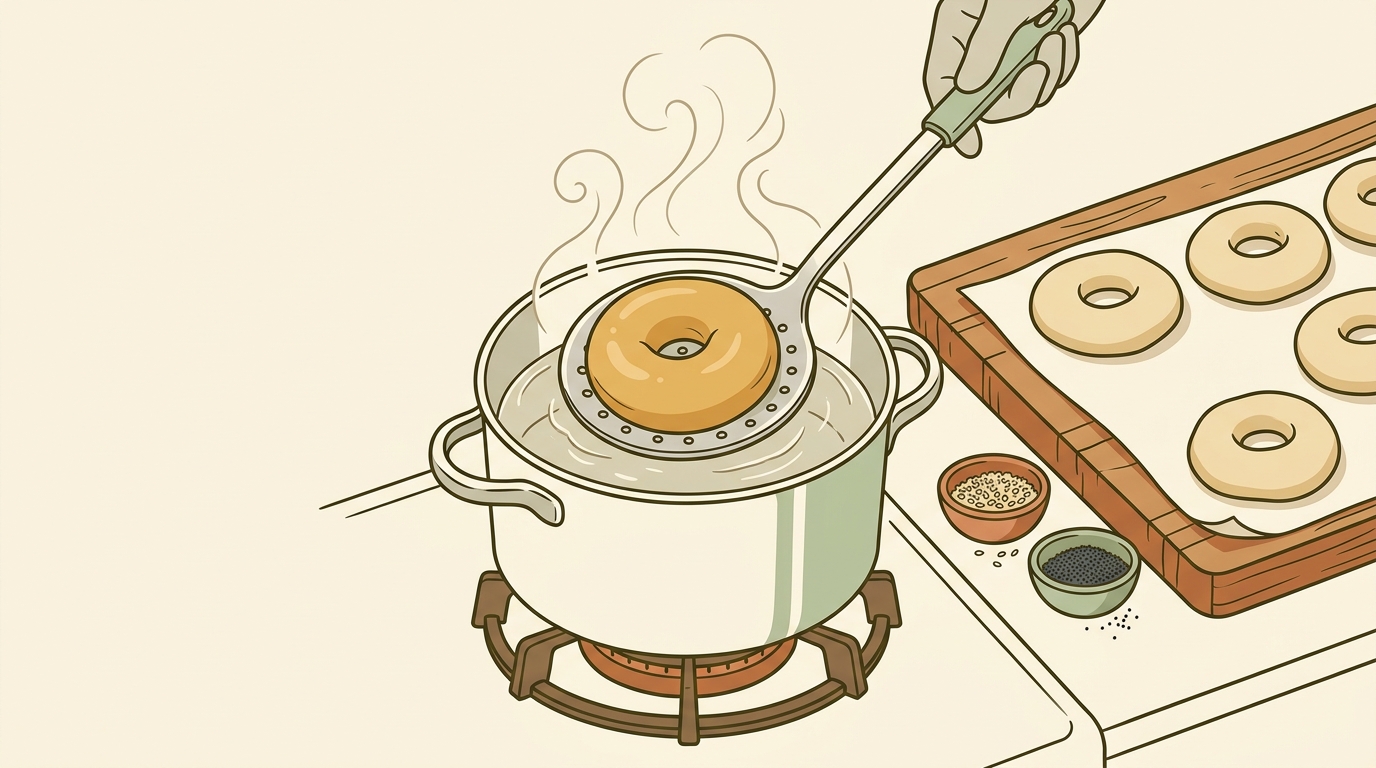
- The Float Test & Boil: Bring 4 quarts of water and malt syrup to a rolling boil. Remove bagels from the fridge and test one in a small bowl of water. When it floats, gently drop 2 to 3 bagels into the boiling pot at a time. Boil 45 to 60 seconds, flip with a slotted skimmer, and boil another 45 seconds.
- Bake at 425°F (218°C): Transfer directly from the water bath into bowls of seeds (poppy, toasted sesame, everything spice, or coarse flake salt). Place seeded bagels onto parchment-lined baking sheets and bake for 20 to 24 minutes until deeply bronzed and sounding hollow when tapped on the bottom.
Frequently Asked Questions (People Also Ask)
Can I make these bagels without any commercial yeast?
Yes, provided your sourdough starter is active and ripe rather than stagnant discard. If using 100% wild levain, extend the room-temperature bulk fermentation to 4-6 hours until the dough has increased in volume by 50% before shaping and overnight cold retarding.
Why did my bagels wrinkle or deflate after boiling?
Wrinkled, deflated bagels indicate overproofing. If the dough fermented too long before boiling, the gluten network becomes over-stretched and acidic. When exposed to boiling water, the weakened protein walls collapse under the heat shock. Always boil bagels straight from cold refrigeration.
How should I store homemade sourdough bagels?
Store in a paper bag for the first 24 hours to preserve crust crispness. For longer storage, slice the cooled bagels in half, place them in a freezer-safe zip-top bag with parchment paper between slices, and freeze for up to 3 months. Toast directly from frozen.