Smoked Chicken Brine: Equilibrium Salinity & Crispy Skin Guide
⚖️ Calculate Exact Brine Salinity for Poultry
Avoid bitter over-salted chicken. Switch between Diamond Crystal, Morton, or fine sea salt in our interactive brine calculator to get exact gram measurements:
Open Poultry Brine Calculator →Smoking whole chicken is one of the greatest joys of backyard wood-fire cooking—yet it is notoriously easy to botch. Unlike pork shoulder or beef brisket packed with rich intramuscular fat and collagen that melts over 12 hours, a chicken is lean poultry. Subjecting a raw, unbrined chicken to the dry convection currents of a 225°F smoker for three hours guarantees chalky, stringy breast meat and rubbery, bite-resistant skin.
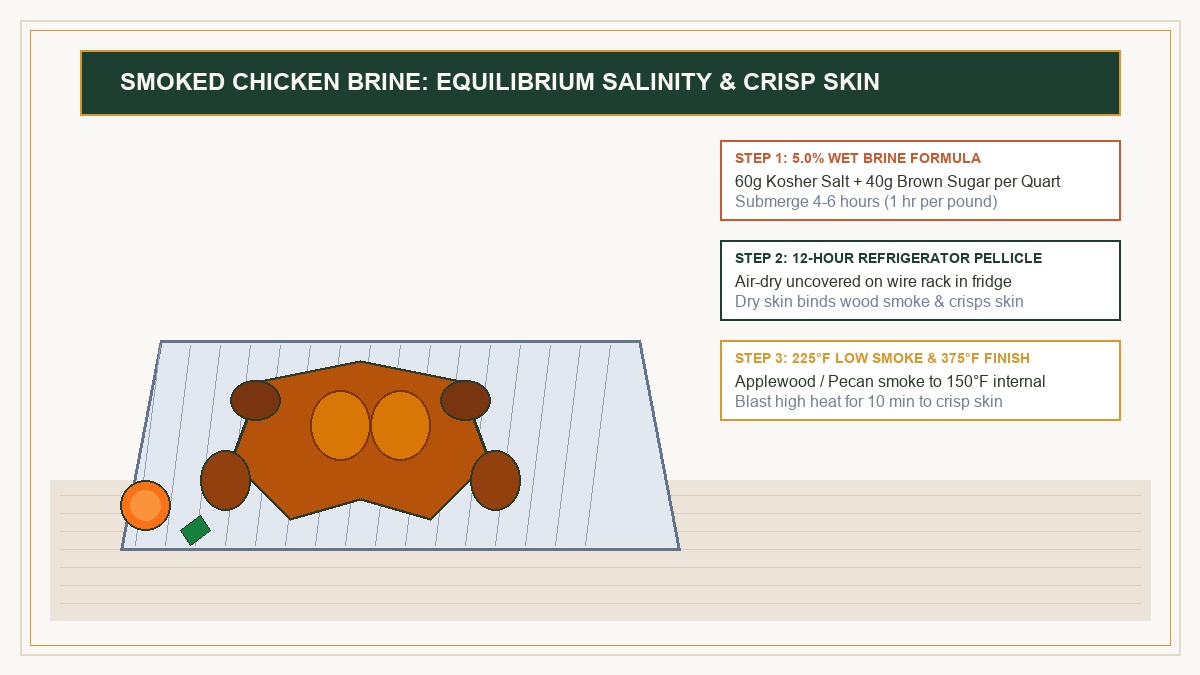
The solution is a scientifically formulated 5.0% Equilibrium Wet Brine paired with a 12-hour refrigerator pellicle rest. Brining saturates muscle filaments with moisture and seasoning, while the pellicle rest ensures your poultry skin emerges from the smoker with a paper-crisp, mahogany crunch.
The Osmotic Formula: Sugar, Salt & Flavor Diffusion
A smoked chicken brine differs fundamentally from a Thanksgiving turkey brine in a bag. Because smoking occurs over hours of vaporized wood combustion, adding brown sugar or pure maple syrup is essential:
| Component | Amount per Quart of Water | Metric Weight | Biochemical Duty |
|---|---|---|---|
| Diamond Crystal Kosher Salt | ~7.5 Tablespoons | 60g (5.0% Salinity) | Denatures myosin proteins to hold cellular moisture |
| Dark Brown Sugar | ~3.0 Tablespoons | 40g (3.3% Sugar) | Buffers salt bite; drives Maillard smoke caramelization |
| Black Peppercorns (Cracked) | 1 Tablespoon | 8.0g | Lipophilic aromatics that infuse skin fat |
| Crushed Fresh Garlic | 4 Cloves | ~20g | Allicin savory complexity |
| Bay Leaves & Fresh Thyme | 2 Leaves + 4 Sprigs | ~5g | Herbal phenolic bouquet |
| Quartered Orange / Lemon | 1/2 Fruit | ~60g | Citric acidity to brighten rich poultry fat |
Why Spatchcocking Is Mandatory for Smoked Poultry
Never smoke a chicken trussed into a round ball. A whole trussed chicken creates an internal hollow cavity that traps stagnant cold air, forcing you to smoke the bird longer to bring the interior thighs to a safe 165°F (74°C)—drying out the breast in the process.
Spatchcocking (Butterflying): Take heavy kitchen shears and cut down both sides of the backbone, removing the spine completely. Flip the chicken breast-side up and press firmly down on the center of the breastbone with the palm of your hand until you hear a sharp snap.
- Uniform Thickness: The chicken now lies completely flat in a two-dimensional plane. All parts of the breast and thighs cook at the exact same rate.
- Total Skin Exposure: All skin faces upward toward the rising heat and wood smoke, eliminating the soggy, un-rendered skin commonly found on the underside of trussed birds.
- Faster Cooking: Spatchcocked chicken smokes in roughly 90 to 110 minutes at 250°F—cutting cooking time by 40% and drastically reducing moisture loss!
The Pellicle Secret: How Wood Smoke Bonds with Protein
Wood smoke is not a gas; it is a suspension of microscopic droplets containing water, vaporized oils, and aromatic organic compounds (phenols, syringol, and guaiacol).
If you transfer wet chicken directly from a liquid brine into a smoker, the wet skin forms an impenetrable water-vapor barrier. The smoke cannot adhere; it washes off with condensation, producing a patchy, dull, gray color and bitter flavor.
🌬️ The 12-Hour Pellicle Rule:
Remove the chicken from the brine, pat completely bone-dry with paper towels, and place it on an elevated wire cooling rack inside a rimmed baking sheet. Transfer uncovered to your refrigerator for 12 to 18 hours. The cold circulating fan air dehydrates the skin proteins into a shiny, slightly sticky film called a pellicle. This tacky protein layer acts like a molecular magnet, locking in wood smoke phenols and guaranteeing a gorgeous mahogany-amber glaze.
The Two-Stage Heat Schedule: Solving Rubbery Skin
- Phase 1: Wood Smoke Ingestion (225°F–250°F / 107°C–121°C): Place the spatchcocked chicken skin-side up on the smoker grate. Add 2 chunks of seasoned applewood or cherry wood. Smoke for 60 to 75 minutes until an instant-read probe in the thickest part of the breast registers 145°F (63°C).
- Phase 2: High-Heat Skin Crisp (375°F–400°F / 190°C–204°C): Low 225°F heat cannot render chicken skin fat. To avoid rubbery skin, crank your smoker vents open (or transfer to a 400°F preheated kitchen oven) for the final 10 to 15 minutes. The intense heat renders the subcutaneous fat beneath the skin, frying it from within until blistered and crackling crisp, while the internal breast temp hits 160°F–165°F.
Frequently Asked Questions (People Also Ask)
Can I add curing salt (pink salt) to smoked chicken brine?
No. Unless you are intentionally making commercial smoked chicken cold cuts or poultry ham, do not use sodium nitrite. Chicken cooks rapidly past 165°F, far beyond the danger zone for botulism. Pure culinary kosher salt provides all the moisture retention and seasoning you need.
Why does my smoked chicken have pink meat near the bone?
A pink ring beneath the skin or near bones in smoked poultry is completely normal and is a hallmark of authentic barbecue! Nitric oxide and carbon monoxide gases in clean wood combustion react with myoglobin in the meat, forming a stable pink compound (carboxyhemoglobin). As long as an instant-read digital thermometer reads 165°F, the meat is fully cooked and safe.
How does smoked chicken brine compare to turkey brine?
Chicken brining requires much less time: only 4 to 6 hours compared to 16 to 24 hours for a whole turkey. Leaving small poultry in a wet brine overnight will oversaturate the thin meat fibers, causing mushiness. Read our dry brine vs wet brine comparison for more details.