Homemade Pancetta Curing: Rolled vs. Flat (Arrotolata vs. Tesa) Guide
⚖️ Calculate Exact Pancetta Curing Salt #2
Pancetta hangs for weeks and requires Prague Powder #2 nitrate protection. Compute exact salt and nitrate grams for your pork belly weight:
Open Charcuterie Curing Calculator →In the pantheon of Italian cured meats, pancetta occupies a sacred place. While American bacon is hot-smoked and cooked until crispy for breakfast, authentic Italian pancetta is dry-cured with fragrant Mediterranean aromatics—juniper, rosemary, garlic, and tellicherry pepper—and dried slowly in cool air until shelf-stable.
Pancetta is the indispensable heartbeat of Roman pasta classics like Spaghetti alla Carbonara and Bucatini all'Amatriciana. When cured properly at home using equilibrium curing math, the rich pork belly fat cures into a buttery, melt-in-your-mouth delicacy that renders clear, aromatic liquid gold in the sauté pan.
Arrotolata (Rolled) vs. Tesa (Flat Slab): The Safety Dilemma
Italian pancetta exists in two distinct historical styles:
| Style | Preparation | Drying Dynamics | Recommended For |
|---|---|---|---|
| Pancetta Tesa (Flat Slab) | Cured as a flat rectangular slab with skin on or off | Fast, uniform 360° moisture evaporation; zero air pocket risk | Beginners: Virtually foolproof; perfect for slicing into lardons |
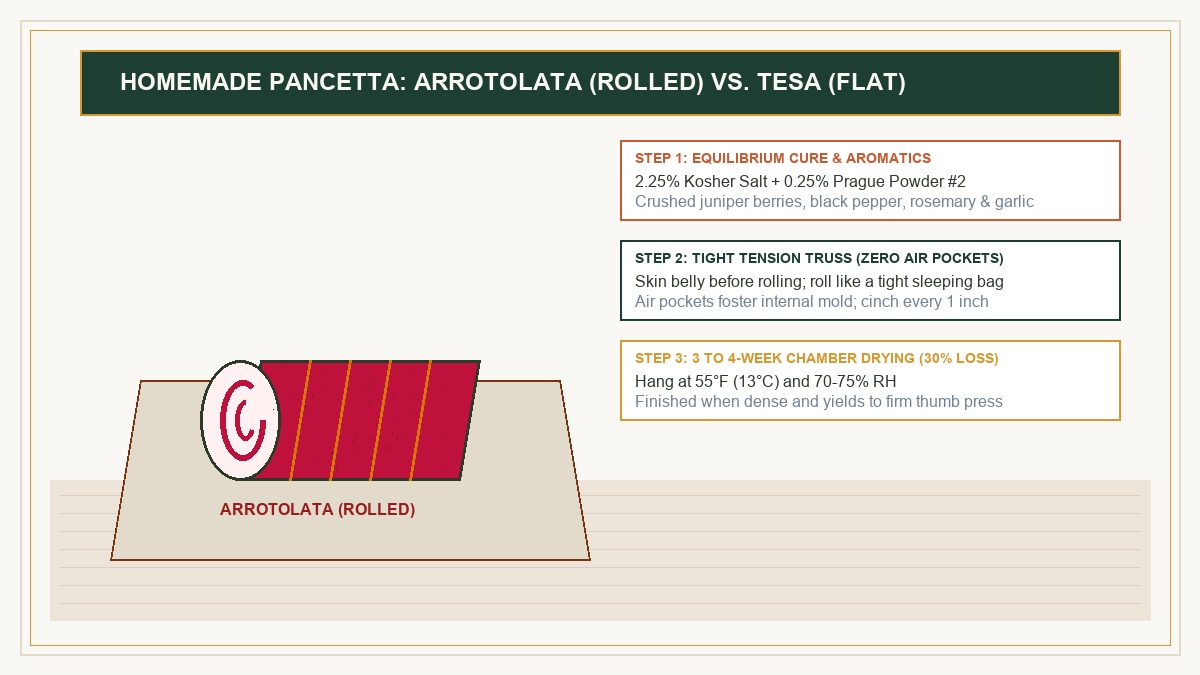
| Pancetta Arrotolata (Rolled) | Skin removed; rolled into a tight spiral cylinder and trussed | Moisture must escape through outer surface and cylinder ends | Intermediate: Iconic round slices for antipasto boards |
The Air Void Hazard in Arrotolata: If you choose to make rolled pancetta, you must understand the primary risk: internal air pockets. If the belly is rolled loosely, microscopic gaps of trapped air remain between the folds. Because moisture is trapped in the center, humidity inside an air pocket hits 100%, creating an ideal breeding ground for unwanted molds. To eliminate this, you must deskin the belly completely and truss with extreme, tight tension.
The Master Italian Equilibrium Cure Formula
Because pancetta hangs in a curing chamber for 3 to 5 weeks without cooking, you must use Prague Powder #2 (which contains sodium nitrate) to provide continuous, time-released protection against botulism as the pork dries:
📐 The Heritage Pancetta Ratio (per 1,000g Pork Belly):
- Trimmed Pork Belly (Skinless): 1,000g (100%)
- Fine Non-Iodized Sea Salt: 22.5g (2.25%)
- Prague Powder #2: 2.5g (0.25% / 156 PPM Nitrite)
- Turbinado / Dextrose Sugar: 5.0g (0.50%)
- Cracked Black Peppercorns: 8.0g (0.80%)
- Crushed Juniper Berries: 3.0g (0.30%)
- Minced Fresh Rosemary: 2.0g (0.20%)
- Grated Fresh Nutmeg: 1.0g (0.10%)
- Minced Garlic: 4.0g (0.40%)
Step-by-Step Production Protocol
- Deskin and Square the Belly: Place the fresh pork belly skin-side up. Using an ultra-sharp boning knife, slice the tough skin away in smooth passes, making sure not to gouge into the precious white fat below. Square the edges into a neat rectangle.
- Apply Equilibrium Rub: Combine your sea salt, Prague Powder #2, sugar, and crushed spices. Rub every square inch of the meat and fat over a rimmed baking sheet.
- The 10-to-12 Day Refrigerator Cure: Vacuum seal the seasoned pork belly in a food-grade bag. Refrigerate at 36°F–38°F (2°C–3°C) for 10 to 12 days, flipping the bag once daily to distribute the extracted brine.
- Rinse and Dry: Remove belly from bag. Rinse off surface salt and loose spices under cold water for 15 seconds. Pat completely bone-dry with paper towels.
- The Tight Spiral Roll: Dust the red meat side with an extra layer of freshly cracked black pepper. Starting from the short end, roll the belly into an extremely tight, compact cylinder—pulling and stretching the meat with your fingers so no air gaps exist between layers.
- High-Tension Butcher's Trussing: Tie a butcher's knot at one end of the cylinder using heavy-duty cotton twine. Loop the twine around the roll every 1 inch under strong tension, cinching the pork so tightly that the layers begin to fuse together. Tie off securely.
- Chamber Drying to 30% Weight Loss: Hang the trussed roll in a curing chamber at 52°F–57°F (11°C–14°C) and 70%–75% relative humidity. Weigh every 5 days. When total weight drops by 28% to 30% (typically 3 to 4 weeks), your pancetta is fully cured, firm, and ready to carve!
Frequently Asked Questions (People Also Ask)
Can I make pancetta without Prague Powder #2?
For flat Pancetta Tesa dried in a clean refrigerator, some traditional purists use 2.75% pure sea salt alone. However, for rolled Pancetta Arrotolata, Prague Powder #2 is mandatory for food safety. The anaerobic environment inside the rolled center requires active nitrates to prevent Clostridium botulinum spore germination.
What should I do if white mold grows on the outer twine?
Chalky white, powdery surface mold (Penicillium nalgiovense) is completely beneficial and normal in European salumi making; it creates a natural armor against spoilage. If you see fuzzy green, black, or slimy mold, wipe the surface down immediately with a clean cloth soaked in distilled white vinegar.
Can I dry pancetta in a regular kitchen refrigerator?
Yes, flat Pancetta Tesa cures wonderfully in a standard refrigerator! Simply rest the cured slab uncovered on an elevated wire rack in the vegetable crisper drawer for 3 to 4 weeks. For rolled Arrotolata, use a breathable dry-aging bag (like UMAi Dry) to prevent the outer rim from drying out too fast.