Sourdough Discard English Muffins: Nooks, Crannies & Griddle Guide
🥖 Calculate English Muffin Hydration Ratios
English muffins require high hydration (78% to 82%) to produce deep steam-expanded crevices. Calculate your milk and discard hydration offsets in our precision baker's tool:
Open Sourdough Hydration Calculator →Few baked goods are more universally beloved than a freshly toasted English muffin slathered in salted cultured butter and orange marmalade. Yet supermarket English muffins are frequently dry, sponge-like rounds with tight, uniform sandwich-bread crumb structures that fail to hold melted butter.
Authentic English muffins are not baked in an oven; they are griddled on a heavy stovetop cast-iron surface. When you combine the biological acidity of sourdough discard with high hydration (78%–82%) and coarse semolina flour, steam expanding between gluten strands creates an irregular, cavernous honeycomb of nooks and crannies that no commercial mass-produced muffin can match.
The Science of "Nooks & Crannies": Hydration & Steam
What physically causes the irregular, open pockets in an English muffin? It is a three-way collision of gluten elasticity, moisture vaporization, and chemical leavening:
- High Hydration (78%–82%): Stiff doughs (like our 56% hydration sourdough bagels) produce tight, dense crumbs. High-hydration doughs trap copious free water molecules between gluten strands. When heated rapidly on a 315°F griddle, this water converts to pressurized steam, blowing open large internal cavities.
- The Acid-Base Carbon Dioxide Burst: Adding 1/2 teaspoon of baking soda to acidic sourdough discard creates an instantaneous chemical effervescence. Sodium bicarbonate reacts with lactic acid ($CH_3CH(OH)COOH$) to liberate thousands of carbon dioxide ($CO_2$) micro-bubbles just as the muffins hit the heat.
- Top & Bottom Crust Enclosure: Because English muffins cook flat against a hot griddle surface on both sides, the top and bottom crusts cook first, trapping the boiling steam inside and forcing it to blast sideways through the crumb.
Baker's Percentages Formulation (8-Muffin Batch)
| Component | Baker's % | Metric Weight | Culinary Role |
|---|---|---|---|
| Unbleached All-Purpose / Bread Flour | 100.0% | 350g (Total Flour) | 11.7%–12.5% protein for delicate chew |
| Whole Milk (Lukewarm) | 68.0% | 200g (Offset for discard) | Lactose sugars for griddle browning & softness |
| Sourdough Discard (100% Hydr.) | 28.5% | 100g (50g flour + 50g water) | Organic acid complexity & CO2 pre-seeding |
| Unsalted Butter (Melted) | 5.7% | 20g | Enriches dough & tenderizes gluten crumb |
| Honey / Raw Sugar | 4.3% | 15g | Balancing sweetness & browning |
| Fine Sea Salt | 2.0% | 7.0g | Tightens gluten elasticity |
| Baking Soda (Added at Griddle) | 0.7% | 2.5g | Neutralizes acidity & creates nooks |
| Coarse Semolina / Cornmeal | As needed | ~40g (for coating) | Thermal insulation & classic crunchy rim |
The Semolina Shield & Griddle Temperature Physics
Cooking a high-hydration dough directly on hot iron without burning is challenging. This is where coarse semolina or yellow cornmeal plays an indispensable thermodynamic role:
🌡️ The 315°F Thermal Buffer:
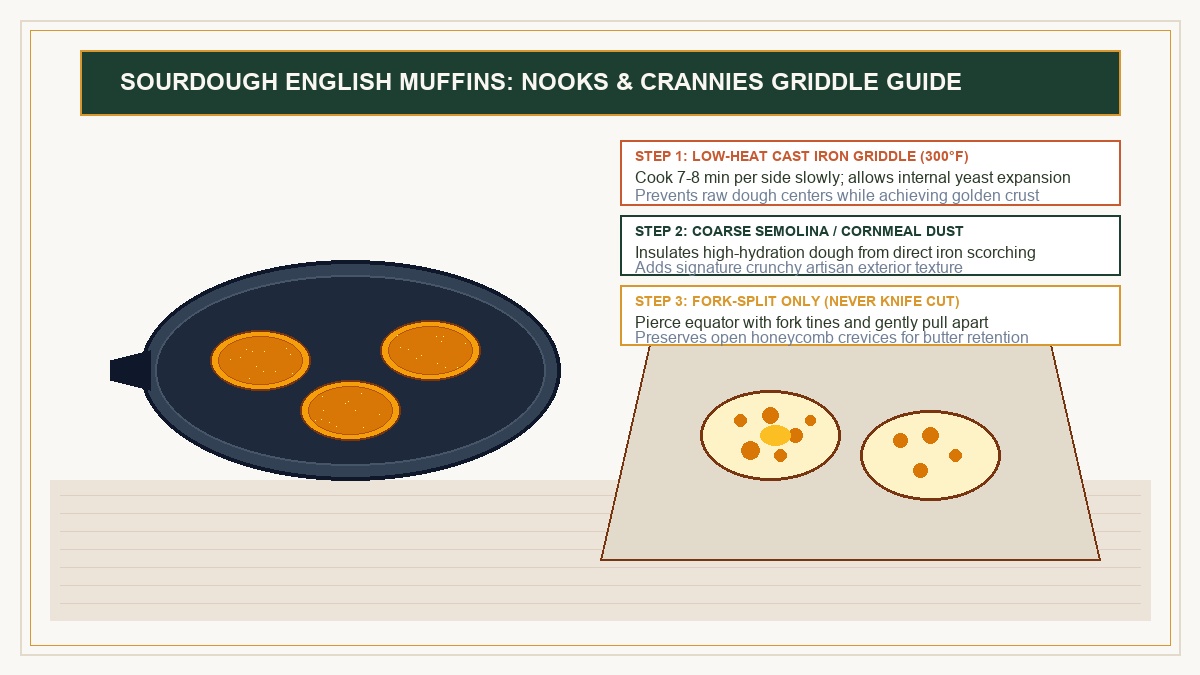
The tiny granules of semolina act like thousands of microscopic ball bearings underneath the dough. They lift the wet dough fractionally off the iron surface, creating microscopic air pockets that buffer heat conduction. This allows the muffins to cook gently for a full 7 to 8 minutes per side at 310°F–325°F, ensuring the center reaches an internal temperature of 200°F (93°C) without scorching the exterior.
The Cardinal Rule: Why You Must Fork-Split
You can execute the fermentation and griddle baking flawlessly, but if you take a sharp serrated bread knife and slice your English muffin in half, you have destroyed the entire point of the bake.
A chef's knife or serrated knife operates by shear friction: as the blade passes through the muffin, it slices across the delicate steam-tunnel walls, crushing the gluten membrane flat and creating a smooth, sheared surface identical to ordinary sandwich toast.
The Fork-Split Method: Take a standard dinner fork and insert the tines horizontally around the equator of the muffin at 1-inch intervals until you have punctured the perimeter. Then, use your fingers to gently pull the two halves apart. The bread naturally fractures along the path of least resistance—exposing the wild, cavernous jagged craters where butter and jam will pool into heavenly reservoirs!
Frequently Asked Questions (People Also Ask)
Do I need English muffin ring molds to make these?
No! While metal rings produce perfectly cylindrical restaurant muffins, free-form English muffins are the traditional farmhouse standard. Simply shape dough balls, flatten gently into 1/2-inch thick discs, roll in semolina, and let rest 20 minutes before griddling. They will puff beautifully into rustic artisan pucks.
Can I use water instead of milk in English muffin dough?
Yes, but whole milk is strongly recommended. Milk proteins and lactose sugars soften the crumb structure and encourage golden caramelization on the stovetop. Water-based doughs will produce a crispier, chewier crust more similar to a crumpet or sourdough loaf.
Why are my English muffins doughy or gummy in the center?
Gummy centers mean your griddle was too hot, causing the crust to brown before internal starches reached full gelatinization (200°F / 93°C). Lower your stove flame to medium-low, cook for a full 8 minutes per side, and verify internal temperature with an instant-read probe thermometer.