Dry Brine for Rotisserie Chicken: Self-Basting & Crisp Skin Science
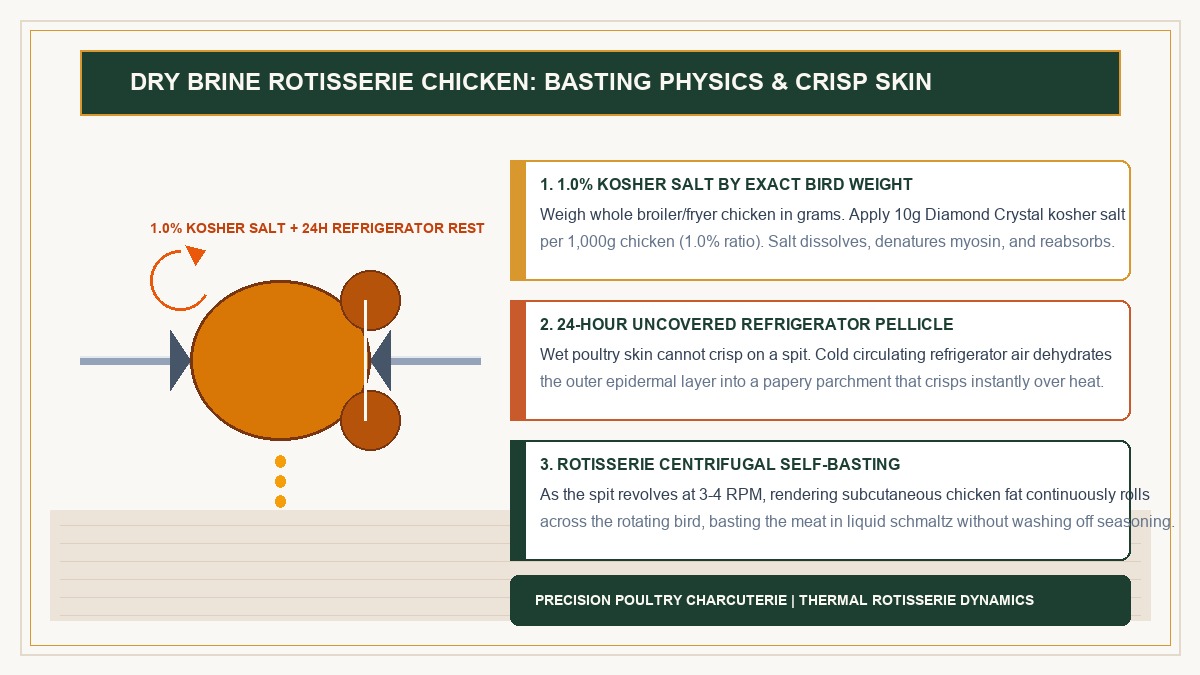
Walk into any classic French bistro or street-corner rotisserie in Paris, and the sight is mesmerizing: rows of whole chickens turning slowly on revolving horizontal spits, glowing amber over radiant heat, dripping golden fat onto roasting potatoes below. The skin is blistered and translucent like potato chips; the white breast meat is miraculously juicy and succulent.
Yet, when home cooks attempt rotisserie chicken on their backyard grill or countertop roaster, the result is often disappointing: rubbery skin that slips off the meat, unevenly salted cavities, or breast meat that dries into chalk before the thigh joints cook through. Replicating bistro-grade rotisserie chicken requires understanding the dual physics of dry brining (salting without water dilution) and centrifugal fat basting.
The Science: Why Wet Brining Destroys Rotisserie Skin
For large holiday whole turkeys or lean turkey breasts, wet brining in seasoned water can be wonderful for infusing liquid deep into dense meat. But on a revolving rotisserie spit, wet brining is your greatest enemy:
| Brining Method | Skin Hydration | Thermal Dynamics on Spit | Final Skin Texture |
|---|---|---|---|
| Wet Brining | Skin absorbs ~10% excess water | Energy is wasted boiling off surface water; skin steams rather than roasts | Rubbery & Flabby: Fails to achieve Maillard crisping |
| Dry Brining (Our Method) | Dehydrated, papery parchment | Skin immediately fries in its own rendered subcutaneous schmaltz at 300°F+ | Glass-Crisp & Blistered: Shattering, golden, bite-through skin |
The Osmotic Mechanism: When coarse kosher salt is applied to raw chicken, it draws out surface water beads via osmosis. Over the next 4 to 6 hours, that concentrated brine dissolves muscle proteins (myosin), relaxing the filaments so they permanently reabsorb the salted liquid deep into the meat fibers. Over the remaining 18 hours in the refrigerator, the cold, circulating air evaporates surface moisture, creating a dry epidermal parchment that crisps instantly over radiant heat. Review our dry brine vs wet brine master comparison.
The Master Rotisserie Dry Brine Formula (per 1,000g Bird Weight)
Never measure salt by volume (teaspoons/tablespoons); crystal size varies wildly between brands. Use a digital scale to compute 1.0% to 1.1% salt by weight based on our kosher salt density conversion guide:
📐 Master Rotisserie Rub (per 4.0 lb / 1,800g Chicken):
- Whole Broiler/Fryer Chicken: 1,800g (approx 4.0 lbs)
- Diamond Crystal Kosher Salt: 19.0g (1.05% by weight — or 14g Morton Kosher)
- Baking Powder (Aluminum-Free): 4.0g / 1 tsp (alkaline pH raises skin surface pH to accelerate blistering)
- Freshly Cracked Black Pepper: 4.0g / 1 tsp
- Smoked Sweet Paprika: 4.0g / 1 tsp (rich color and subtle woodsmoke depth)
- Garlic Powder & Dried Thyme: 2.0g each (1/2 tsp each)
- Cavity Aromatics: 1/2 lemon, 4 smashed garlic cloves, 3 fresh rosemary sprigs
Step-by-Step Rotisserie Protocol
- Trim and Pat Dry: Remove giblets from cavity. Trim excess tail fat and loose neck skin. Pat the chicken bone-dry inside and out with paper towels.
- Under-the-Skin Salting: Gently slide your fingers between the breast meat and the skin, separating the delicate membrane without tearing the outer skin. Rub approximately 1/3 of your measured salt directly onto the raw meat beneath the skin.
- Coat the Exterior: Mix remaining salt, baking powder, black pepper, paprika, and herbs. Dust evenly over the entire outer skin, drumsticks, wings, and inside the cavity.
- The 24-Hour Refrigerator Pellicle Rest: Place the chicken breast-up on an elevated wire cooling rack set inside a rimmed baking sheet. Refrigerate uncovered for 18 to 24 hours. The skin will darken slightly and dry into a thin, translucent, tight sheet.
- Stuff Cavity & Spit-Truss: Stuff the cavity with lemon, garlic, and rosemary sprigs. Slide the first rotisserie prong onto the spit rod. Insert rod through the cavity, pushing the bird firmly onto the prongs. Slide the second prong in and tighten the thumb screws securely. Truss drumsticks together with butcher's twine and pin wings tightly against the breast so nothing flops during rotation.
- Roast over Indirect Radiant Heat: Set grill or roaster to 375°F (190°C) with a drip pan placed directly beneath the chicken (set between indirect burners). Turn on the rotisserie motor. The bird will turn at 3 to 4 RPM. As subcutaneous fat renders, it will roll over the rotating skin, self-basting continuously for 60 to 75 minutes.
- Check Temperature & Rest: Chicken is finished when an instant-read thermometer inserted into the deepest part of the breast reads 165°F (74°C) and the inner thigh joint registers 175°F (80°C). Carefully remove spit using heat-resistant gloves. Rest upright for 15 minutes before carving to allow juices to redistribute!
Frequently Asked Questions (People Also Ask)
Why is baking powder added to the dry brine?
Baking powder (which contains sodium bicarbonate) is mildly alkaline. Lightly dusting it onto poultry skin raises the surface pH. An elevated alkaline pH accelerates the Maillard browning reaction and weakens collagen proteins in the skin, allowing moisture to escape rapidly and forming microscopic air blisters that result in shatteringly crisp, crackling skin.
Can I rotisserie roast a chicken if I only have a regular oven?
Yes! If you don't have a motorized spit, you can replicate rotisserie results in a standard oven using a vertical poultry roaster (beer-can style stand). Roast at 400°F (205°C) on an elevated rack; vertical roasting allows heat to circulate 360 degrees around the bird while fat renders smoothly downward.
Can I dry brine chicken pieces instead of a whole bird?
Yes! Bone-in, skin-on chicken thighs, drumsticks, and split breasts dry brine beautifully. Because individual pieces have a higher surface-area-to-weight ratio, reduce refrigeration time to 6 to 12 hours. Compare with our smoked chicken brine guide for low-and-slow woodsmoke methods.
What should I do with the rotisserie pan drippings?
The liquid gold collecting in your drip pan is concentrated, herb-infused poultry schmaltz. Toss sliced baby potatoes, carrots, or cubed sourdough bread directly into the drip pan during the final 30 minutes of roasting; the vegetables will caramelize in the hot chicken fat, creating the ultimate French bistro side dish!
Explore More Precision Poultry & Meat Brining:
From whole holiday turkeys to rotisserie poultry, master the math behind succulence:
- Visit the comprehensive Poultry & Meat Brining Pillar Hub.
- Master holiday poultry with our Citrus Turkey Brine Guide.
- Calculate whole bird salinity with our Interactive Turkey Brine Calculator.