Citrus Turkey Brine: Acidity Ratios, Terpenes & Crisp Skin Science
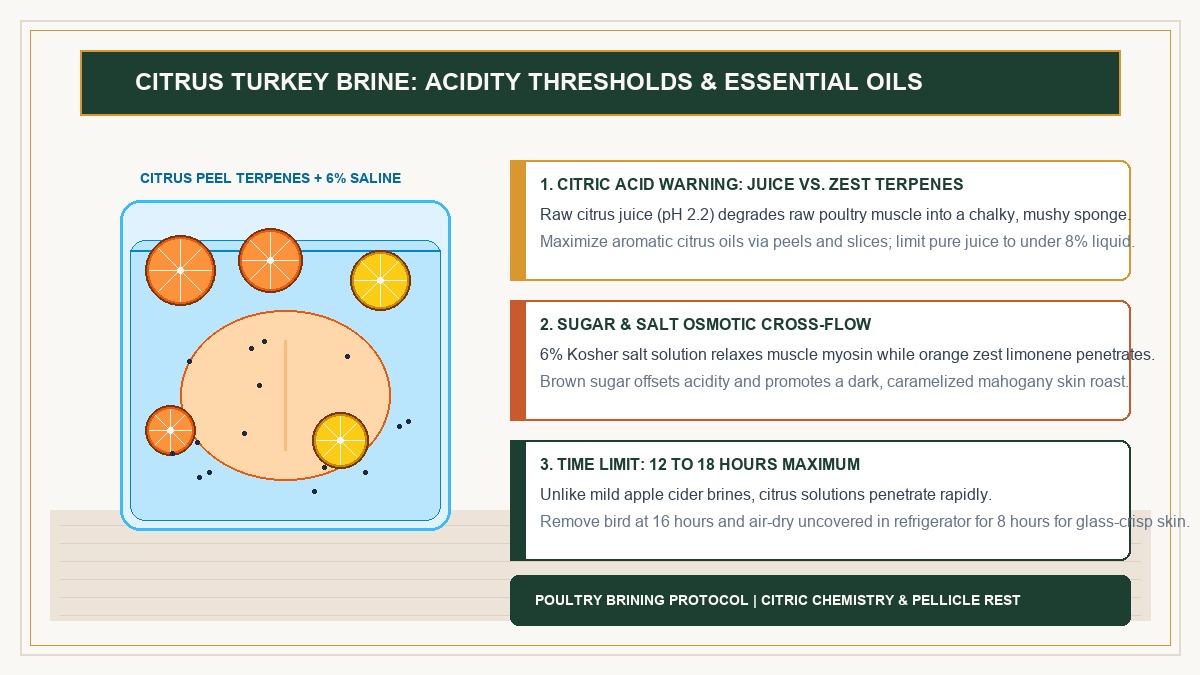
As Thanksgiving and holiday feasts approach, home cooks look for ways to elevate traditional roast poultry beyond plain salt and water. Among all aromatic variations, citrus turkey brine—infused with bright navel oranges, fragrant lemons, cracked peppercorns, and fresh rosemary—is celebrated for imparting a sunny Mediterranean perfume and vibrant acidity to rich dark and white meat.
However, citrus brining is also where rookie cooks encounter catastrophic texture failure. When home cooks pour gallons of store-bought orange or lemon juice over a raw turkey, they inadvertently trigger rapid enzymatic acid denaturing. Instead of juicy, firm breast meat, they pull a bird from the oven with the texture of soggy chalk. Mastering citrus brining requires understanding the fundamental chemical divide between acidic fruit juice and aromatic peel terpenes.
The Science: Juice Acidity vs. Peel Terpenes (Limonene)
The reason many holiday recipes fail is a misunderstanding of where citrus flavor actually lives. The vibrant, fresh aroma associated with orange and lemon does not come from citric acid; it lives in the flavedo (the colored outer peel):
| Citrus Component | Chemical Compounds | pH Level | Impact on Poultry Muscle |
|---|---|---|---|
| Citrus Juice (Lemon/Lime) | Citric acid, malic acid, ascorbic acid | 2.0 - 2.5 (High Acid) | Danger Zone: Denatures muscle myosin rapidly; turns meat chalky and mushy if over-concentrated. |
| Citrus Juice (Orange) | Citric acid, fructose, glucose | 3.3 - 3.8 (Moderate Acid) | Gentler tenderizer, but high sugars can scorch skin if not tempered by salt. |
| Citrus Peels (Zest) | D-limonene, linalool, myrcene (essential oils) | Neutral (Non-Acidic) | The Pure Flavor Secret: Highly aromatic essential oils dissolve into brine without degrading protein structure. |
The Golden Rule of Citrus Brining: Extract 90% of your citrus aroma from the bruised outer peels (zest) where non-acidic oil glands reside. Cap your actual liquid citrus juice to no more than 5% of the total brine volume. This delivers an explosive citrus aroma throughout the meat while keeping muscle fibers firm and succulent. If you are comparing this with orchard fruit solutions, read our apple cider turkey brine guide.
The Master Citrus Brine Formula (per 4 Liters / 1 Gallon Water)
This formula is calibrated for a 12-to-16 pound whole turkey or 6-to-8 pounds of bone-in turkey breasts. It maintains a 6.0% salinity level to optimize osmotic penetration:
📐 The Master Citrus Brine Ratio:
- Cold Filtered Water: 4,000ml / 4 Liters (100% liquid base — approx 1 gallon)
- Diamond Crystal Kosher Salt: 240g (6.0% salinity) — or 180g Morton Kosher; see our salt ratio guide
- Dark Brown Sugar: 150g (3.75% — balances acidity, promotes mahogany roasting color)
- Navel Oranges: 3 large (peels stripped in wide ribbons; juice of only 1 orange)
- Eureka or Meyer Lemons: 2 large (peels stripped in wide ribbons; juice of only 1 lemon)
- Fresh Rosemary Sprigs: 4 sprigs (lightly bruised)
- Fresh Thyme Bunches: 6 sprigs
- Whole Black Peppercorns: 1.5 tablespoons (coarsely cracked)
- Garlic Cloves: 6 cloves (smashed)
*Have a larger bird? Use our interactive turkey brine calculator to compute exact salt grams for any water container size.
Step-by-Step Production Protocol
- Extract Peel Aromatics: Using a sharp vegetable peeler, shave wide ribbons of orange and lemon zest, avoiding the bitter white pith. Place peels on a cutting board and press firmly with the flat side of a chef's knife to release the volatile citrus oils.
- The Hot Steep Base: In a medium pot, bring 1 liter (1 quart) of water to a simmer. Add kosher salt, brown sugar, cracked black peppercorns, crushed garlic, and bruised citrus peels. Stir until completely dissolved. Remove from heat, toss in rosemary and thyme sprigs, and let steep for 15 minutes.
- Chill with Cold Water: Pour the concentrated steep into your brining container. Add remaining 3 liters of ice-cold water and the freshly squeezed juice of 1 orange and 1 lemon. Crucial Food Safety Step: Test brine with a digital probe thermometer. The brine must be below 38°F (3°C) before your turkey enters. Never submerge raw poultry in lukewarm liquid!
- The 12-to-16 Hour Submersion: Lower the turkey breast-side down into the brine, ensuring it is completely submerged. If brining in a bucket or cooler, weigh the bird down with a sanitized heavy plate; if brining in a bag, review our bag brining technique. Seal and refrigerate for 12 to 16 hours.
- Rinse and Mandatory Air-Dry: Remove turkey from brine. Discard liquid and spent peels. Rinse bird briefly inside and out under cold running water for 15 seconds. Pat completely dry with lint-free paper towels.
- The Refrigerator Pellicle Rest (8 to 12 Hours): Place turkey uncovered on an elevated roasting rack set inside a rimmed roasting pan. Refrigerate uncovered for 8 to 12 hours. The cold, dry refrigerator air dries the wet skin into a thin, translucent, papery film. This step is non-negotiable for crispy holiday skin!
- Roast to Perfection: Brush dried skin with softened herb butter or oil. Roast at 425°F (220°C) for the first 30 minutes, then reduce to 325°F (165°C) until an instant-read probe in the thickest part of the breast reaches 160°F (71°C) and the thigh registers 175°F (80°C). Rest 30 minutes before carving!
Check Your Turkey: Pre-Brined Warning
Before buying ingredients, inspect the fine print on your turkey's butcher label. Many commercial supermarket turkeys (Butterball, Shady Brook, Honeysuckle) are industrially injected with a 4% to 9.5% sodium phosphate solution.
Submerging an industrially pre-brined bird in a standard 6% wet brine will result in overwhelmingly salty, unpalatable meat. If your turkey package contains terms like *"Contains up to 8% retained water"* or *"basted with a solution of broth, salt, and natural flavor"*, refer to our pre-brined turkey survival protocol to adjust salinity.
Frequently Asked Questions (People Also Ask)
Can I use citrus brine on chicken or turkey breast?
Yes! Citrus brine is phenomenal on bone-in turkey breasts, spatchcocked chickens, and bone-in pork chops. Because smaller poultry cuts have a higher surface-area-to-volume ratio, reduce brining time accordingly: 4 to 6 hours for whole chickens, and 6 to 8 hours for bone-in turkey breasts. Check out our turkey breast brining guide for specific formulas.
Can I add fresh cranberries or limes to the brine?
Fresh cranberries add festive color and subtle astringent tannins, but because whole cranberries have waxy skins, you must simmer them in the hot steep until they pop to release their juice. Lime peels add vibrant tropical notes, but limit lime juice strictly, as its high acid content easily over-tenderizes white poultry meat.
Why did my turkey skin turn dark so quickly during roasting?
Citrus brines contain natural fruit fructose and brown sugar, both of which accelerate Maillard browning and sugar caramelization. If your turkey skin achieves a deep golden mahogany color within the first 60 minutes of roasting, simply tent a sheet of aluminum foil loosely over the breast and drumsticks for the remainder of the cook.
Can I make a dry brine with citrus instead?
Yes! If you prefer dry brining, rub fresh orange and lemon zest directly into kosher salt and brown sugar (using your fingers to express the fragrant oils into the salt crystals). Rub the citrus salt mixture under and over the turkey skin and rest uncovered in the refrigerator for 24 to 48 hours. Review our dry brine vs wet brine master comparison.
Master Precision Meat Brining:
Whether preparing holiday poultry or whole-muscle barbecue, scientific salting guarantees succulent results:
- Visit the comprehensive Poultry & Meat Brining Pillar Hub.
- Pair your bird with our holiday Artisan Sourdough Stuffing Guide.
- Explore cold and hot smoking with our Smoked Fish Brine Guide.