Smoked Fish Brine: Wet vs Dry Brine Ratios, Salinity & Pellicle Science
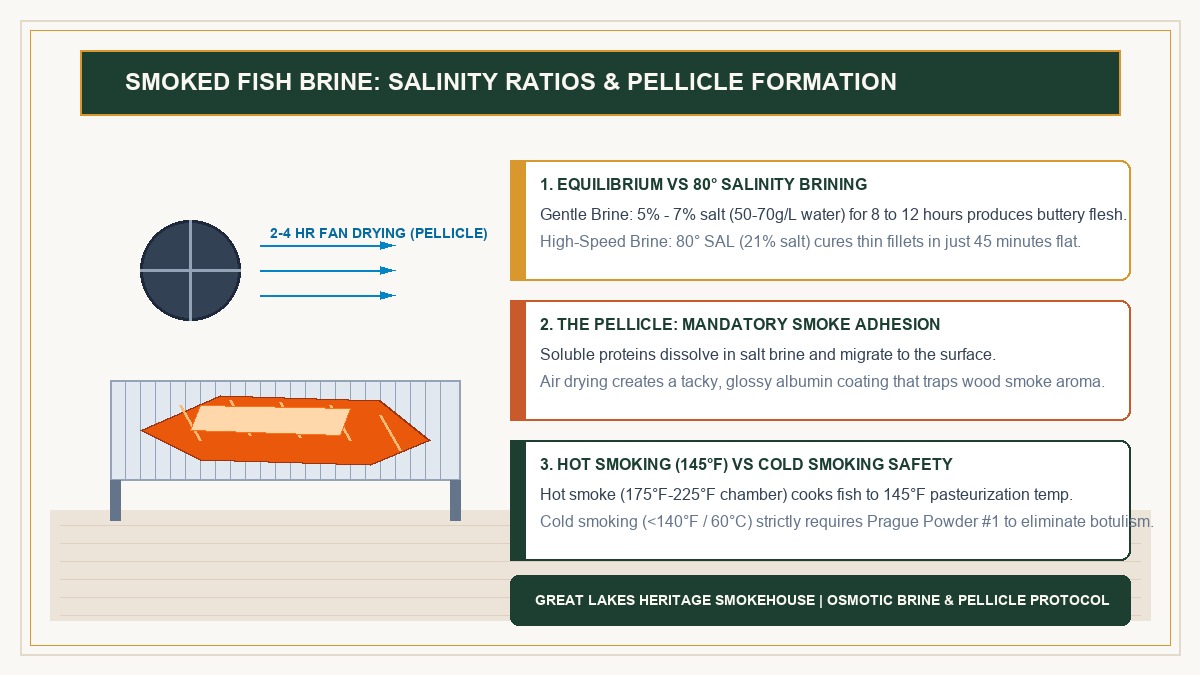
Along the shoreline of Lake Michigan and across the river valleys of Wisconsin, few culinary traditions are as revered as the heritage fish smokehouse. From silver-scaled lake whitefish and fatty lake trout to king salmon, smoking fish is a delicate balance of preservation, moisture retention, and deep woodsmoke perfume. Yet, countless backyard smoking projects end in tragedy: dry, chalky flesh, a muddy gray exterior, or an unsightly explosion of white curd weeping from the meat.
Baking great smoked fish does not start with expensive hardwood or digital pellet grills; it starts in the brine. Brining fish serves two biochemical purposes that heat alone cannot accomplish: denaturing surface myofibrillar proteins to lock in moisture, and developing the pellicle—the glossy, tacky albumin sheen that captures wood smoke aerosols while keeping the delicate flesh luscious and buttery.
Wet Brining vs. Dry Brining: Choosing the Correct Method
Unlike dense poultry or pork, fish muscle is composed of short, fragile muscle fibers called myotomes separated by thin sheets of connective collagen called myocommata. Choosing between wet brining and dry curing fundamentally changes the texture:
| Method | Mechanism | Resulting Texture | Ideal Fish Species |
|---|---|---|---|
| Gentle Wet Brine (5% - 7%) | Fillets submerged in cold water + salt + brown sugar for 8-12 hours | Plump, silky, juicy, buttery flakes | Hot-Smoked Salmon, Lake Trout, Whitefish, Arctic Char |
| High-Speed Wet Brine (80° SAL) | High saturation (21% salt) flash brine for 30-45 minutes | Uniform outer cure, fast commercial turnaround | Thin whitefish fillets, smelts, perch |
| Dry Cure (2:1 Sugar to Salt) | Crystalline sugar and salt packed directly onto flesh for 4-8 hours | Dense, firm, chewy, candy-lacquered finish | Cold-Smoked Lox, Hard Salmon Jerky, Steelhead |
For home smokers seeking the legendary flaky, juicy texture of hot-smoked salmon or Great Lakes whitefish, the gentle wet brine is overwhelmingly superior. It prevents over-salting, distributes aromatics evenly, and allows gradual osmotic penetration without crushing delicate cell membranes. If you are brining whole poultry, compare this with our dry brine vs wet brine master analysis.
The Master Smoked Fish Brine Formula
This formula is calibrated for 3 to 4 pounds of fresh salmon, trout, or whitefish fillets. Always use non-iodized salt (Diamond Crystal or Morton kosher salt; refer to our kosher salt density conversion guide) and keep the brine refrigerated below 38°F (3°C):
📐 Master Wet Brine Ratio (per 2,000ml / 2 Quarts Cold Water):
- Cold Filtered Water: 2,000g / 2 Liters (100%)
- Diamond Crystal Kosher Salt: 120g (6.0% salinity) — or 90g Morton Kosher
- Dark Brown Sugar: 90g (4.5% — balances salt, provides caramelization base)
- Pure Maple Syrup or Honey: 30g (1.5% — heritage sweetness and glaze)
- Crushed Whole Allspice Berries: 6 berries
- Whole Black Peppercorns (cracked): 1 tablespoon
- Dried Bay Leaves: 2 leaves (crushed)
- Whole Garlic Cloves (smashed): 3 cloves
*Scaling for larger catches? Use our brining salinity calculator to compute exact gram weights for any water volume.
The Crucial Phase: Air-Drying the Pellicle
The biggest mistake rookie pitmasters make is taking wet fish directly from the brine bucket into a hot smoker. If you put wet fish into smoke, two disasters occur:
- Creosote Condensation: Wood smoke aerosols adhere to water vapor droplets, forming an acidic, black, bitter coating called creosote that ruins flavor.
- Albumin Bleeding (White Curd): Heat rapidly coagulates unsealed surface proteins, forcing white gelatinous curd to erupt all over the fillet.
How to Form the Perfect Pellicle: Remove fillets from brine, rinse for 10 seconds under cold water to remove surface salt crystals, and pat dry with lint-free paper towels. Place fillets skin-side down on elevated stainless steel cooling wire racks. Place the racks in a cool room (or refrigerator) directly in front of an electric fan set on low speed. Allow air to circulate across the flesh for 2 to 4 hours. When ready, the flesh will transform from wet and soft to a shiny, lacquer-like, dry film that feels sticky and tacky to a gentle finger touch.
Step-by-Step Smokehouse Protocol
- Debone and Portion: Lay fresh salmon or trout fillets flat. Run your index finger down the center line to locate pin bones. Pull each bone cleanly at an angle with needle-nose pliers. Slice fillets into uniform 4-inch wide portions.
- Dissolve & Chill Brine: Whisk kosher salt and brown sugar into 500ml of boiling water until completely clear. Add remaining 1,500ml of ice-cold water and aromatics. Ensure brine temperature is below 38°F (3°C).
- Overnight Submersion: Place fish portions skin-side up in a glass or food-safe plastic container. Pour brine over fish until fully submerged. Cover and refrigerate for 8 to 12 hours.
- Rinse and Dry: Drain brine. Rinse each fillet briefly. Pat dry.
- Fan-Dry Pellicle: Arrange on wire racks over baking sheets. Run fan on low for 2 to 3 hours until tacky and glossy.
- Progressive Smoke Ramp: Preheat smoker to 150°F (65°C) using alder, applewood, or sugar maple chips. Smoke for 60 minutes at this low heat. Then raise smoker temperature to 175°F (80°C) for 60 minutes. Finally, raise to 200°F (93°C) until the thickest portion of the fish registers 145°F (63°C) on an instant-read probe.
- Rest and Glaze: Brush hot fillets with warm maple syrup or honey during the final 15 minutes of smoking. Cool to room temperature, then chill in refrigerator for 4 hours before serving for clean, firm slicing.
Frequently Asked Questions (People Also Ask)
What wood species is best for smoking fish?
Alder is the undisputed traditional gold standard for smoking salmon and trout across the Pacific Northwest and Great Lakes. It imparts a delicate, sweet, non-bitter smoke that complements rather than overpowers delicate fish oils. Applewood, pecan, and sugar maple are also exceptional. Avoid heavy, pungent woods like mesquite or hickory, which will completely overwhelm delicate seafood.
Can I smoke fish with the skin off?
Always leave the skin ON during brining and smoking. Fish skin serves as a structural barrier that prevents delicate fillets from falling apart between wire rack grates. Furthermore, natural fats concentrated between the skin and meat insulate the fillet from drying out during long smoking sessions. You can easily peel the skin away after cooking if desired.
How long does homemade smoked fish last?
Hot-smoked fish cooked to 145°F (63°C) will keep wrapped tightly in the refrigerator for 7 to 10 days. If vacuum-sealed, it will remain fresh for up to 3 weeks in the refrigerator, or up to 6 months frozen without loss of texture or smoky aroma.
Can I use frozen fish for smoking?
Yes! In fact, commercially frozen salmon or trout is preferred by many professional smokehouses because freezing destroys potential parasites (such as *Anisakis* worms). Thaw the fish completely in the refrigerator over 24 hours before submerging in the brine. Do not brine partially frozen fish, as ice crystals inhibit salt diffusion.
Continue Your Meat & Poultry Brining Journey:
Brining is the ultimate culinary bridge between tender, succulent meat and profound smoky flavor.
- Visit the comprehensive Poultry & Meat Brining Pillar Guide for whole-bird formulas.
- Explore whole poultry smoking with our Smoked Chicken Brine Guide.
- Perfect holiday roasts with our Dry-Brined Prime Rib Protocol.