Homemade Bresaola Curing: Dry-Cured Beef Equilibrium Method & Chamber Safety
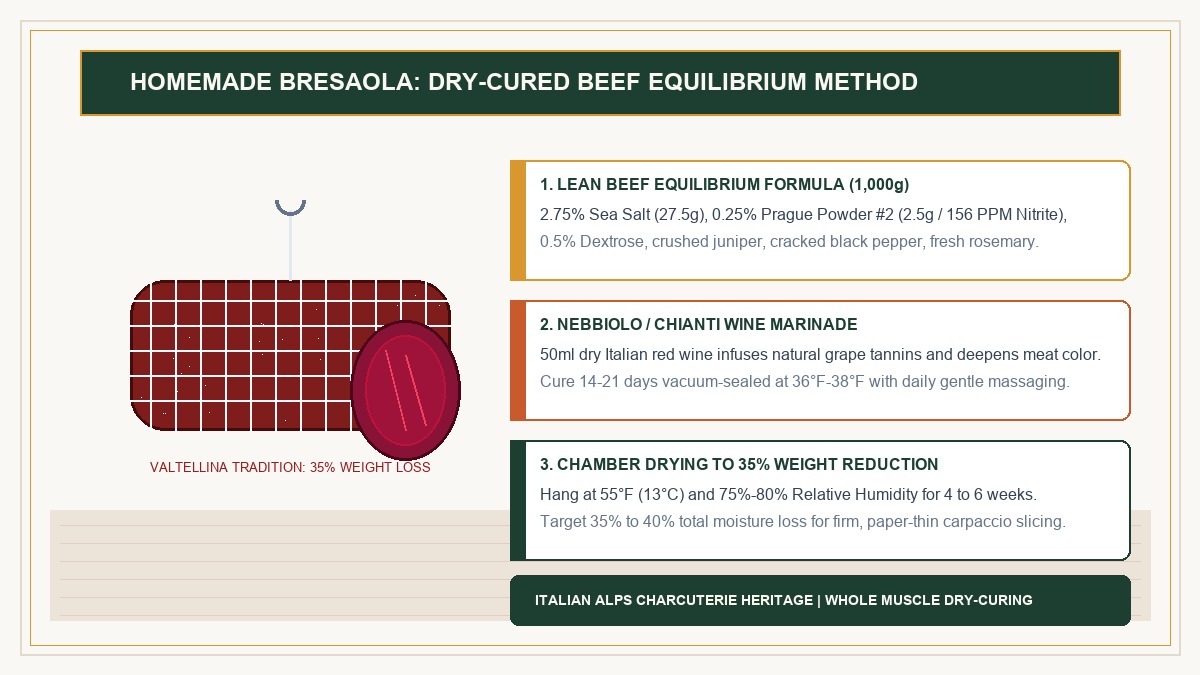
While pork reigns supreme across most European salumi traditions—from homemade pancetta to dry-cured prosciutto—the high alpine valleys of Valtellina in northern Lombardy developed Italy's most celebrated beef masterpiece: Bresaola della Valtellina. Cured in the crisp, dry winds blowing down from the Swiss Alps, authentic bresaola is deep ruby, silky, and profoundly lean, redolent of mountain juniper, rosemary, and dry red wine.
For the aspiring home charcutier, bresaola is widely considered the single best project for mastering dry-curing. Unlike salami, which requires grinding, precise bacterial culture inoculation, and fermentation kinetics, bresaola is a whole-muscle cure. Because intact muscle interiors are naturally sterile, your primary task is controlling exterior surface ecology, executing precision equilibrium curing math, and managing steady dehydration until the meat concentrates into a translucent, jewel-like delicacy.
Selecting the Beef: Why Lean Muscle Is Mandatory
In fresh steaks like ribeye or brisket, intramuscular fat marbling is the holy grail of tenderness. In long-aged charcuterie, however, beef fat is your enemy. Beef fat has a high concentration of unsaturated fatty acids that undergo oxidative rancidity much faster than pork lard. A fatty cut aged for six weeks will develop a stale, greasy, candle-wax flavor:
| Beef Cut | Muscle Group | Fat / Gristle Profile | Suitability Rating |
|---|---|---|---|
| Eye of Round (Semitendinosus) | Hind leg / round | Zero intramuscular fat; uniform cylindrical shape; consistent drying diameter | THE GOLD STANDARD (10/10) |
| Top Round (Inside Round) | Upper hind leg | Very lean, dense grain; requires dividing along natural muscle seams | EXCELLENT (9/10) |
| Sirloin Tip (Knuckle) | Front of rear leg | Lean but irregular geometry; requires heavy trussing to equalize drying | GOOD (7/10) |
| Beef Tenderloin (Filet Mignon) | Spine interior | Ultra-tender but excessively soft; dries into a fragile, mushy texture | POOR (4/10) |
Trimming Protocol: Before weighing or curing, place your beef eye of round roast on a cutting board. Using a razor-sharp boning knife, shave away every square millimeter of exterior fat cap, silvery gristle, and loose connective tissue. You must be left with 100% solid, deep purple-red lean muscle.
The Master Alpine Equilibrium Cure Formula
Because bresaola hangs in a curing chamber for 4 to 8 weeks, it requires Prague Powder #2 (which contains sodium nitrate) to ensure sustained protection against botulism as water activity ($a_w$) drops below 0.85. Calculate all ingredients as strict percentages of the clean trimmed beef weight:
📐 Master Bresaola Ratios (per 1,000g Trimmed Lean Beef):
- Trimmed Beef Eye of Round: 1,000g (100% green weight)
- Fine Non-Iodized Sea Salt: 27.5g (2.75% — ideal savory profile without harshness)
- Prague Powder #2: 2.5g (0.25% — provides mandatory 156 PPM sodium nitrite)
- Dextrose / Turbinado Sugar: 6.0g (0.60% — feeds beneficial aging microflora)
- Cracked Tellicherry Black Peppercorns: 8.0g (0.80%)
- Crushed Juniper Berries: 4.0g (0.40% — signature alpine botanical aroma)
- Fresh Rosemary (finely minced): 2.5g (0.25%)
- Fresh Thyme Leaves: 1.5g (0.15%)
- Ground Nutmeg & Cinnamon: 1.0g combined (0.10%)
- Dry Italian Red Wine (Nebbiolo / Chianti): 50ml (adds natural grape tannins and deep color)
*Compute exact curing metrics for your roast weight with our curing salt calculator.
Step-by-Step Production Protocol
- Trim and Record Green Weight: Aggressively trim all fat and silverskin from the roast. Place on a precision digital kitchen scale and record the exact starting weight in grams (this is your Green Weight).
- Apply Equilibrium Rub: In a small bowl, thoroughly mix the sea salt, Prague Powder #2, dextrose, and ground aromatics. Rub the mixture vigorously across all sides of the beef cylinder, pressing spices into the grain.
- Wine Marinade & Vacuum Seal: Place the seasoned beef inside a heavy-duty vacuum seal bag. Pour in the 50ml of dry red wine. Vacuum seal on maximum setting.
- The 14-to-18 Day Curing Phase: Place the sealed bag flat in a refrigerator maintained at 36°F to 38°F (2°C to 3°C). Flip and massage the meat once every 24 hours. The salt will draw out liquid into a dark red brine, which will then re-absorb as the meat achieves osmotic equilibrium.
- Rinse and Dry: Remove beef from bag. Rinse briefly under cold tap water for 15 seconds to remove loose surface spices. Pat completely bone-dry with lint-free paper towels.
- Casing & Netting: Slide the roast into a rehydrated beef bung (or wrap tightly in edible collagen charcuterie film). Slide the wrapped beef into elastic butcher's netting (size 18 to 22) to maintain tight, even radial tension as the cylinder shrinks during drying.
- Chamber Aging to 35%-40% Loss: Hang the netted bresaola in a temperature- and humidity-controlled curing chamber set to 53°F–57°F (12°C–14°C) with 75%–80% relative humidity. Weigh the roast every 7 days. Once total weight drops by 35% to 40% (typically 4 to 6 weeks depending on roast thickness), your bresaola is fully cured, firm to the touch, and ready to enjoy!
Managing Mold & Preventing Case Hardening
During the 5-week hanging period, two critical environmental factors dictate success:
- Case Hardening (The Enemy): If chamber humidity drops below 70%, the exterior surface of the beef dries out too fast, forming a hard, impermeable leather shell. This traps moisture inside the center of the meat, creating sour, rotting core spoilage. Always keep humidity steady at 75% to 80% RH.
- Beneficial White Mold (Mold 600): Inoculating the exterior casing with Penicillium nalgiovense (Bactoferm Mold 600) creates a chalky, snowy-white protective armor that blocks harmful wild molds, moderates moisture release, and imparts a buttery, earthy aroma. If green, black, or slimy mold appears, wipe down immediately with a clean rag soaked in 5% distilled white vinegar.
Frequently Asked Questions (People Also Ask)
What does bresaola taste like compared to prosciutto?
While pork prosciutto is rich, buttery, and heavily defined by unctuous cured fat, bresaola is intensely lean, savory, and beef-forward. It features complex botanical notes from juniper berries and wine tannins, accompanied by a clean, mineral, slightly peppery finish. When sliced paper-thin, it has a tender, melt-on-the-tongue texture similar to beef carpaccio.
Can I cure bresaola with white wine instead of red wine?
Yes! While bold Italian red wines (Nebbiolo, Barolo, or Chianti) are traditional and impart a deep, dark ruby color, crisp dry white wines (such as Pinot Grigio or Sauvignon Blanc) can also be used. White wine yields a lighter, floral flavor profile and a brighter red interior. Avoid sweet or oaky wines.
How do I know when bresaola is finished drying?
Never rely on calendar days alone; drying speed depends on diameter and chamber airflow. Bresaola is finished strictly by weight reduction math: when current weight equals 60% to 65% of original green weight (representing a 35% to 40% total loss). The meat will feel firm throughout when pressed between your thumb and forefinger, with no soft, spongy center.
How long does cured bresaola last?
Once fully dried to 35% weight reduction, vacuum seal the bresaola block. Rest it in the refrigerator for 2 weeks before slicing—this "equalization phase" redistributes remaining moisture from the center to the edges for effortless carving. Vacuum-sealed in the refrigerator, whole bresaola will keep in pristine condition for up to 12 months.
Explore More Whole-Muscle Artisan Charcuterie:
Continue your charcuterie education across our specialized curing laboratory guides:
- Visit the comprehensive Meat Curing & Charcuterie Pillar Guide.
- Master poultry curing with our Homemade Duck Prosciutto Guide.
- Learn safe nitrite ppm metrics with our USDA Curing Nitrite Safety Standards.