Best Bottles for Kombucha Second Fermentation: Pressure Safety & Carbonation Guide
Brewing homemade kombucha is one of the most rewarding branches of functional food fermentation. Transforming sweetened black tea into a tart, probiotic elixir with a vibrant SCOBY is pure kitchen alchemy. Yet, the true holy grail for home brewers happens in second fermentation (2F): transforming flat, sour liquid into a champagne-like, effervescent craft beverage bursting with micro-bubbles.
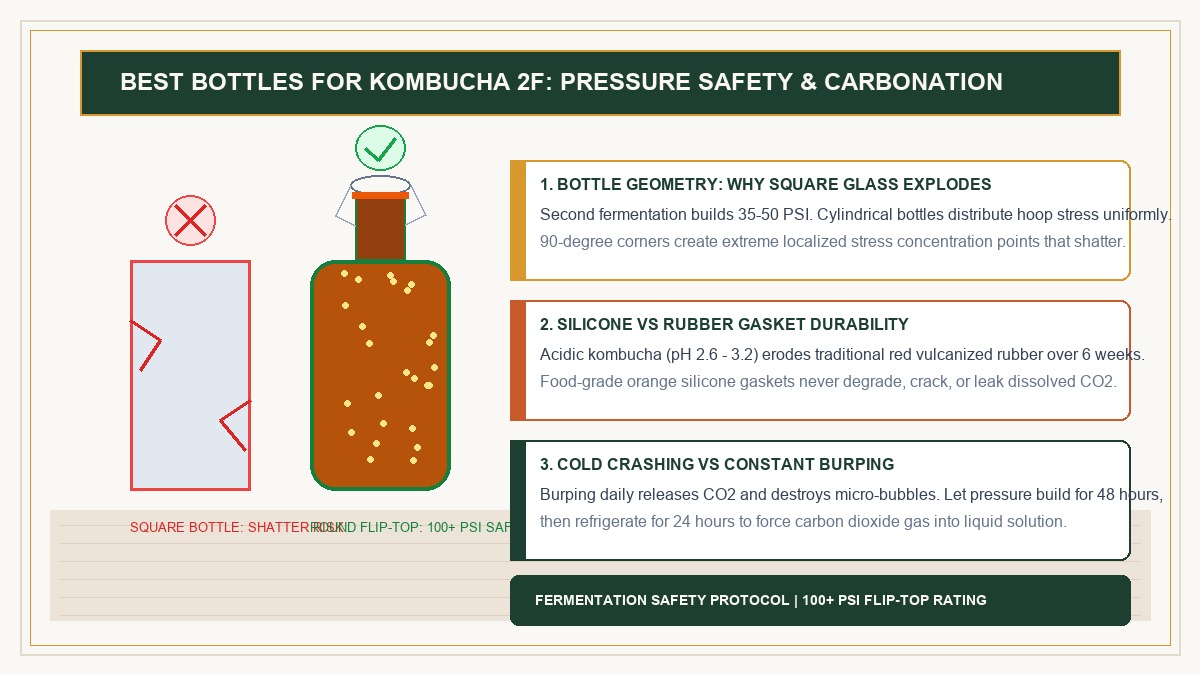
However, that effervescence comes at a serious physical price. When anaerobic wild yeasts consume sugars inside an airtight vessel, they generate massive volumes of carbon dioxide ($CO_2$) gas. In a warm kitchen, internal pressure frequently builds between 35 and 55 PSI—higher than the tire pressure of a passenger vehicle. Every week, unwary home fermenters suffer shattered glass "bottle bombs" simply because they chose decorative olive oil bottles or square decorative carafes. Understanding vessel geometry and pressure physics is paramount to keeping your kitchen safe.
The Engineering Physics: Why Square Bottles Explode
Walk through any home goods store and you will find elegant, square-sided flip-top bottles marketed for vinegar, infused oil, or water. Never use square glass bottles for carbonated fermentation. The danger lies in structural mechanics:
| Vessel Geometry | Stress Distribution | Typical PSI Burst Rating | Safety Assessment |
|---|---|---|---|
| Square / Octagonal Swing-Top | Stress concentrates exponentially at 90° corners; flat walls flex outward | 15 - 25 PSI | DANGEROUS: High risk of catastrophic shrapnel explosion |
| Mason Jars (Canning Jars) | Flat, wide lid flexes; rubber rings warp; jars engineered for negative vacuum, not outward pressure | 20 - 30 PSI | UNSUITABLE: Leaks pressure; micro-bubbles fail to carbonate |
| Standard Beer Bottles (Crown Cap) | Round cylindrical shape; uniform hoop stress distribution | 60 - 80 PSI | EXCELLENT: Requires crown capper tool and disposable metal caps |
| Heavy Round Swing-Top (Grolsch Style) | Thick-walled soda-lime glass cylinder; reinforced wire bail and porcelain cap | 100 - 150 PSI | THE GOLD STANDARD: Reusable, zero-tool hermetic sealing |
The Hoop Stress Equation: In a pressurized cylinder, outward radial tension (hoop stress) is calculated as stress = (P × r) / t (where P is internal pressure, r is inner radius, and t is glass wall thickness). In a round bottle, stress is evenly distributed across a continuous arc. In a square bottle, the corners act as mechanical stress risers where localized tension spikes up to five times higher than the nominal pressure, shearing the glass along microscopic flaws. If you are comparing airlocks and crocks for open ferments, read our fermentation crocks vs jars guide.
Gasket Chemistry: Why Silicone Beats Vulcanized Rubber
The thickest glass bottle is completely useless if the gasket cannot maintain a gas-tight hermetic seal. Most budget swing-top bottles arrive fitted with traditional red vulcanized rubber washers. In the world of kombucha, rubber is an immediate liability:
- Acid Degradation: Kombucha is rich in acetic acid, gluconic acid, and lactic acid with a pH between 2.6 and 3.2. This harsh acidic environment hardens, pits, and cracks natural rubber within 4 to 6 weeks, causing slow carbonation leaks.
- Odor Transfer: Degraded rubber leaches volatile sulfur compounds into the headspace, tainting delicate berry or floral kombucha flavors with a faint tire-like smell.
- The Food-Grade Silicone Advantage: Premium orange or translucent silicone gaskets are chemically inert, impervious to low-pH organic acids, boil-sterilizable, and retain elastic memory for hundreds of fermentation cycles. Always upgrade replacement washers to food-grade silicone.
The Science of Carbonation: Henry's Law & Headspace
Creating explosive carbonation without volcanic erupting requires understanding Henry's Law: the amount of dissolved gas in a liquid is directly proportional to the partial pressure of that gas above the liquid, and inversely proportional to temperature:
📐 The Master Kombucha 2F Primer Ratios (per 16 oz / 500ml Bottle):
- Fermented 1F Kombucha: 15 oz (leave exactly 1.0 to 1.25 inches of headspace)
- Option A (Pure Sugar): 1/2 teaspoon (2.5g) organic cane sugar or maple syrup
- Option B (Whole Fruit Puree): 1.0 to 1.5 oz (30ml) fresh raspberry, blackberry, or ginger puree
- Option C (100% Fruit Juice): 1.5 to 2.0 oz (45ml) tart cherry or pomegranate juice
- Target Fermentation Temp: 72°F to 76°F (22°C to 24°C) for 48 to 72 hours
- Mandatory Cold-Crash: Minimum 24 hours at 36°F (2°C) before opening
Why Headspace Matters: Carbon dioxide gas cannot compress liquids (water is virtually incompressible). If you fill a bottle to the absolute brim, even a tiny volume of $CO_2$ generation will cause hydraulic pressure spikes that crack the neck. Leaving 1.0 to 1.25 inches (2.5 to 3 cm) of headspace provides a compressible gas pocket that buffers pressure safely.
To Burp or Not to Burp: The Great Debate
Internet forums are filled with advice urging beginners to "burp your bottles daily to check pressure." In reality, daily burping is the fastest way to ruin your kombucha:
- Loss of Carbonation: Every time you crack the wire bail, you depressurize the headspace. The $CO_2$ that took 24 hours to form escapes into the kitchen, forcing the yeast to start over. The result is consistently flat kombucha.
- The Volcanic Eruption Hazard: Rapidly opening a warm, carbonated bottle creates sudden nucleation, turning half your kombucha into a geyser that paints your ceiling.
- The Professional Solution (The Control Bottle): Instead of burping glass, fill one small, clean 12 oz plastic soda bottle alongside your glass swing-tops. As fermentation progresses, the plastic bottle will expand and turn rock-hard. When the plastic bottle feels completely rigid and unyielding under thumb pressure, your glass bottles are fully carbonated. Immediately transfer all bottles to the refrigerator!
Frequently Asked Questions (People Also Ask)
What brand of swing-top bottles is the safest?
Authentic European brewing brands are the gold standard. Bormioli Rocco (Giara series), Otis Classic, and genuine recycled 16 oz amber Grolsch beer bottles are manufactured from thick, tempered soda-lime glass engineered to withstand 100 to 150 PSI. Avoid unbranded, ultra-cheap swing-top bottles from dollar stores or craft shops, which are decorative and made of brittle non-tempered glass.
Are amber bottles better than clear bottles for kombucha?
Yes, amber (brown) glass is scientifically superior because it filters out 99% of harmful ultraviolet (UV) light wavelengths. Exposure to direct or indirect sunlight can "skunk" fermentation, killing live probiotic bacteria and degrading beneficial tea polyphenols. If using clear glass bottles, store them inside a dark closed cabinet or cardboard box during second fermentation.
Why is my kombucha flat even after 4 days of second fermentation?
Flat kombucha in 2F is caused by three common issues: 1) Leaking or hardened gaskets failing to hold pressure, 2) Kitchen temperatures below 68°F (20°C), which causes yeast dormancy, or 3) Yeast starvation (not adding enough priming sugar or fruit puree to fuel carbon dioxide production). Ensure your room is warm (74°F-78°F) and gaskets are supple silicone.
How do I sanitize flip-top bottles without breaking them?
Never pour boiling water directly into cold glass bottles; thermal shock will cause immediate cracking. The best method is soaking in a no-rinse brewing sanitizer like Star San (phosphoric acid-based) diluted to 1 oz per 5 gallons of water. Star San is odorless, non-toxic, and leaves an acidic surface coating that protects your kombucha from contamination. Check our fermentation weights and equipment guide for complete sanitization routines.
Expand Your Home Fermentation Laboratory:
From probiotic sparkling beverages to live-culture lactic acid vegetables, safe equipment makes all the difference.
- Visit the master Lacto-Fermentation Pillar Guide for salinity charts and pH science.
- Compute exact salt percentages with the Interactive Fermentation Calculator.
- Explore our crunchy Lacto-Fermented Gherkins Protocol.