Artisan Sourdough Stuffing: Crust, Custard & Moisture Chemistry
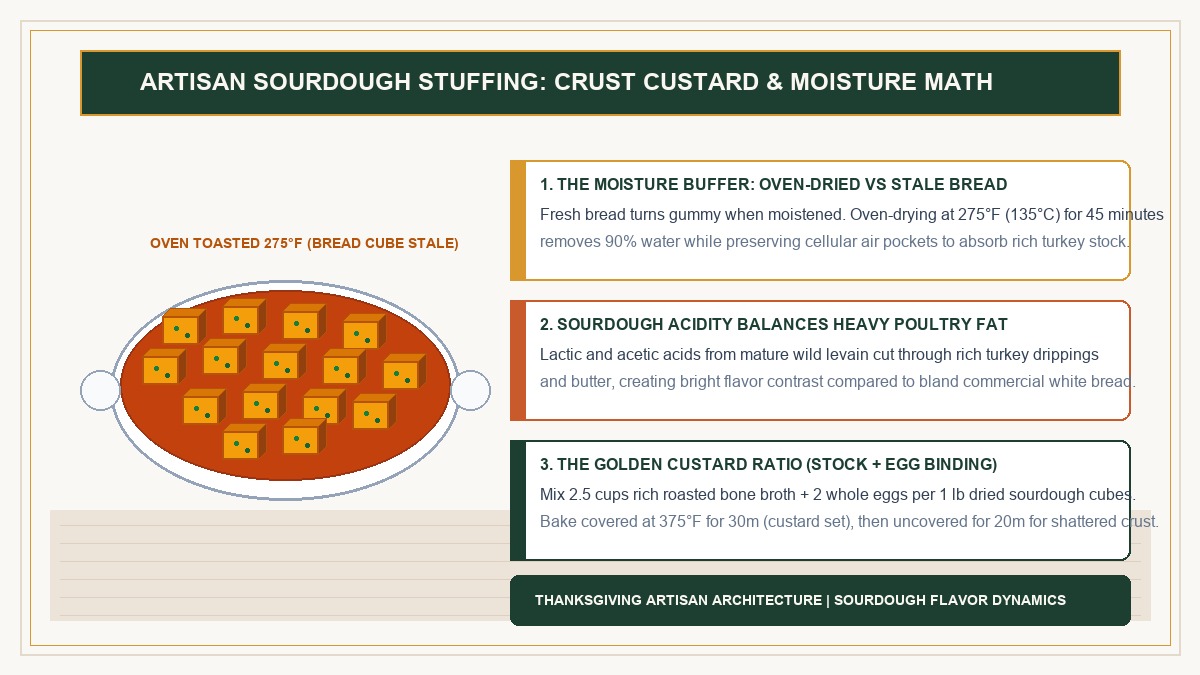
Across the American holiday table, stuffing (or dressing) is often treated as an afterthought—an indiscriminate mash of commercial bagged croutons, dehydrated celery powder, and canned sodium broth. Yet, in the hands of an artisan baker and traditional food preserver, stuffing is one of the highest expressions of culinary physics.
When made with a naturally leavened, open-crumb artisan sourdough boule, stuffing transcends its humble reputation. Sourdough brings two irreplaceable biochemical assets to the table: structural protein integrity that refuses to dissolve into wet mush, and organic acid balance (lactic and acetic acids) that cuts through rich roasted turkey fat, butter-basted skin, and heavy giblet gravies.
The Science of Stale vs. Dehydrated Bread
The most pervasive myth in holiday cooking is that great stuffing is made from "stale bread left on the counter for two days." Understanding food chemistry reveals why this ruins texture:
| Preparation Method | Internal Moisture | Cellular Physics | Culinary Result |
|---|---|---|---|
| Counter-Staled Bread | ~30% to 35% water remaining | Starch retrogradation (amylose crystallization); cell walls are firm but waterlogged | Cannot absorb seasoned broth; dissolves into gummy, dense bread pudding |
| Fresh Bread | ~42% to 46% water | Hydrated soft gluten network; highly absorbent | Instantly collapses into a soggy, gluey paste upon contact with liquid |
| Oven-Dehydrated (275°F / 135°C) | <5% residual water | Water evaporates completely; starch porous network locks into rigid dry lattice | The Perfect Culinary Sponge: Drinks in 250% its weight in broth while keeping distinct bite |
The Dehydration Protocol: Cut your sourdough loaf—whether a rustic boule baked in a Dutch oven or sandwich slices from a bread machine—into uniform 3/4-inch (2cm) cubes. Spread them across two large rimmed baking sheets in a single layer. Bake at 275°F (135°C) for 40 to 45 minutes, stirring twice. The cubes should feel light, dry as croutons, and sound like gravel when tossed, with zero browning.
The Master Sourdough Stuffing Formula
This master formula is balanced for 1 pound (450g) of bone-dry sourdough bread cubes, creating a standard 9x13-inch baking casserole serving 8 to 10 guests:
📐 The Heritage Sourdough Stuffing Ratio:
- Dehydrated Sourdough Cubes: 450g / 1.0 lb (100% dry base — approx 10 to 12 cups)
- Unsalted European Butter: 115g / 1 stick (25% — for sweating mirepoix)
- Yellow Onions (finely diced): 300g (2 medium onions)
- Celery Stalks & Leaves (diced): 200g (4 large stalks)
- Fresh Garlic (minced): 20g (4 cloves)
- Minced Fresh Sage: 2 tablespoons (the Thanksgiving signature)
- Minced Fresh Rosemary: 1 tablespoon
- Minced Fresh Thyme Leaves: 1 tablespoon
- Rich Roasted Turkey or Chicken Bone Broth: 600ml / 2.5 cups (warm)
- Whole Pastured Eggs: 2 large eggs (beaten into broth — custard binder)
- Fine Sea Salt: 7g (1.5 tsp) & Coarse Black Pepper: 3g (1 tsp)
*Cooking for a large gathering? Use our precision recipe scaler to calculate exact ingredient weights for 15, 20, or 30 guests.
Step-by-Step Production & Dual-Bake Protocol
- Oven-Dehydrate the Bread: Cut your sourdough into 3/4-inch cubes. Bake at 275°F (135°C) for 40 to 45 minutes until totally crisp. Let cool completely. Transfer to a very large mixing bowl.
- Sauté the Aromatic Base: In a large heavy skillet or Dutch oven, melt 8 tablespoons of butter over medium heat. Add diced onions, celery, and a pinch of salt. Cook gently for 10 to 12 minutes until soft and sweet, but not browned. Stir in garlic, sage, rosemary, and thyme, cooking for 90 seconds until kitchen aromatics explode.
- Blend the Savory Custard: In a separate bowl or 4-cup measuring pitcher, whisk the warm (not hot!) turkey bone broth, beaten eggs, remaining salt, and freshly ground black pepper.
- The Two-Stage Hydration: Scrape the hot buttery onion-herb mixture over the dry sourdough cubes. Toss with two large spoons until cubes are coated in aromatic fat. Pour 2 cups of the broth-egg custard over the cubes. Fold gently for 60 seconds. Let rest for 3 minutes. Inspect the bottom of the bowl—if dry, add the remaining 1/2 cup of broth. The cubes should be soaked and plump, but not sitting in free liquid.
- Pan and Cover: Generously butter a 9x13-inch ceramic or cast iron baking dish. Transfer stuffing into dish, spreading loosely without pressing or compacting the bread. Dot top with 2 extra tablespoons of butter. Cover tightly with heavy-duty aluminum foil.
- Phase 1 - The Custard Set (Covered): Bake at 375°F (190°C) for 30 minutes. Trapped steam cooks the egg custard, tenderizing the lower cubes into a rich, savory bread pudding.
- Phase 2 - The Crust Shatter (Uncovered): Remove foil. Increase oven heat to 400°F (205°C) and bake for 20 minutes. The exposed bread tips will caramelize into craggy, dark golden, buttery croutons that provide incredible textural contrast against the custardy bottom.
Pairing with Brined Holiday Poultry
Stuffing does not live in a vacuum—it is the direct companion to your centerpiece holiday bird. If you are preparing a whole roast turkey, pairing this stuffing with a properly brined bird creates harmonious flavor:
- Avoid In-Bird Stuffing: Modern food safety guidelines strongly recommend baking stuffing in a separate casserole dish rather than inside the bird's raw cavity. Stuffing inside a turkey requires the internal bread core to reach 165°F (74°C) to kill salmonella, which inevitably overcooks delicate turkey breast meat into dry sawdust.
- The Turkey Dripping Technique: If you want authentic in-bird flavor without the food safety danger, roast your turkey on a V-rack set directly over your roasting pan. During the final 20 minutes of baking, spoon 4 to 6 tablespoons of rendered pan drippings (rich in poultry schmaltz and herbs) over the top of your uncovered sourdough stuffing. If you are wet brining your bird, review our apple cider turkey brine or citrus turkey brine guide.
Frequently Asked Questions (People Also Ask)
Can I add sausage or wild mushrooms to sourdough stuffing?
Yes! Browned pork sausage (like Italian sage sausage) or sautéed wild forest mushrooms (cremini, chanterelles, or shiitake) add deep umami complexity. Brown 1/2 pound of sausage or mushrooms in the skillet first, remove to a bowl, and sweat your onions and celery in the remaining rendered fat. Fold them into the bread cubes during step 4.
Can I make sourdough stuffing vegetarian?
Yes. Simply substitute the turkey bone broth with a rich roasted mushroom and vegetable stock (prepared with caramelized leeks, dried porcini mushrooms, carrots, and thyme). The natural sour tang of the wild levain and the rich butter will ensure a deeply savory, satisfying centerpiece for vegetarian holiday guests.
How do I reheat leftover sourdough stuffing without drying it out?
Transfer leftover stuffing into an oven-safe dish. Drizzle 2 to 3 tablespoons of warm broth over the surface to replenish evaporated moisture. Cover with foil and reheat at 350°F (175°C) for 15 minutes, then uncover for 5 minutes to restore the crispy top crust.
Can I use sourdough discard to bake bread specifically for stuffing?
Yes! If you keep a sourdough starter, you can bake a rustic high-yield discard loaf ahead of the holidays. Check out our formulas in the sourdough discard English muffins and sourdough discard bagels guides, or review our interactive sourdough calculator to plan your holiday baking schedule.
Explore More Holiday Culinary Architecture:
From wild yeast baking to holiday poultry brining, master the math behind traditional feast preparation:
- Visit the master Artisan Sourdough Pillar Guide for baker's math.
- Prepare your holiday centerpiece with the Poultry Brining Master Guide.
- Calculate exact salt and liquid ratios with our Turkey Brine Calculator.