Sourdough Discard Pretzel Bites: Alkaline Bath & Crust Gloss Guide
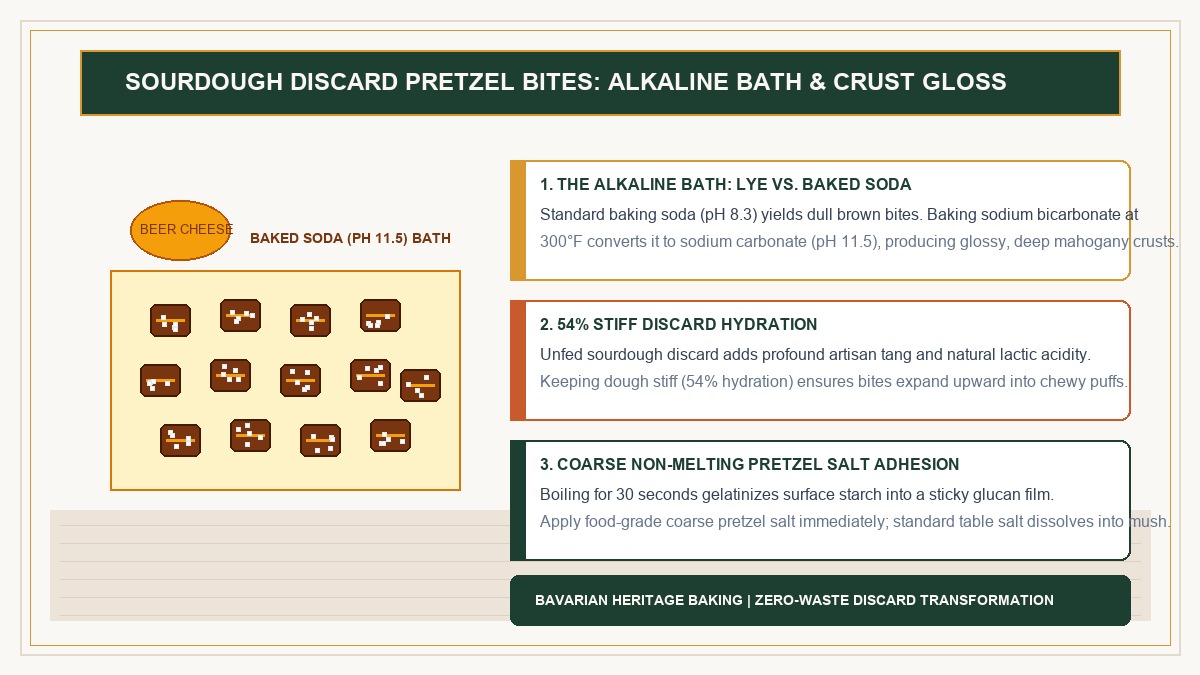
For home bakers maintaining an active wild levain, the weekly surplus of sourdough discard can feel like an obligation. While sweet pancakes and crackers are common outlets, nothing transforms unfed sourdough discard into pure snacking gold like authentic Bavarian-style soft pretzel bites. With their chewy, dense interior, complex fermented tang, deep mahogany-lacquered crust, and crunchy flakes of coarse salt, they are the undisputed kings of game-day snacks and holiday appetizers.
However, most internet recipes produce pale, lackluster rolls that look and taste like dinner rolls rather than pretzels. The secret behind the legendary glossy, chestnut-brown skin and distinct earthy aroma of a German Laugengebäck is alkaline bath chemistry. By mastering the science of baked baking soda (sodium carbonate) and stiff 54% dough hydration, you can produce authentic beer-hall pretzels at home with zero chemical danger.
The Chemistry of the Alkaline Bath: Lye vs. Baked Baking Soda
Why do pretzels have a color and flavor completely unlike sandwich bread? The answer lies in the pH scale:
| Alkaline Source | Chemical Name | pH Level | Safety & Culinary Result |
|---|---|---|---|
| Raw Baking Soda | Sodium Bicarbonate ($NaHCO_3$) | pH 8.3 (Mild) | Safe, but yields dull yellowish-brown crust with faint metallic aftertaste |
| Baked Baking Soda (Our Method) | Sodium Carbonate ($Na_2CO_3$) | pH 11.5 (Strong Alkaline) | The Home Gold Standard: Safe, non-toxic; produces deep mahogany gloss, thin snappy skin, and authentic pretzel aroma |
| Food-Grade Lye | Sodium Hydroxide ($NaOH$) | pH 13.5 - 14.0 (Caustic) | Authentic German bakery standard, but highly corrosive; requires protective goggles and rubber gloves |
How to Make Baked Baking Soda: Spread 1 cup of standard baking soda across a rimmed baking sheet lined with foil. Bake in an oven at 300°F (150°C) for 60 minutes. As it bakes, heat drives off water and carbon dioxide: 2 NaHCO3 → Na2CO3 + H2O + CO2. The powder will lose approximately 30% of its weight, transforming into sodium carbonate—a powerful, kitchen-safe alkaline agent that produces professional pretzel gloss.
The Master Sourdough Discard Pretzel Formula
Unlike high-hydration boules, authentic pretzels require a stiff 54% hydration dough. This stiffness prevents the dough from absorbing excess water during the boiling bath, ensuring bites puff upward into chewy pillows rather than flattening out:
📐 Master Pretzel Formula (48 Bites):
- Unbleached All-Purpose or Bread Flour: 350g (100%)
- Unfed Sourdough Discard (100% hydration): 200g (57% — contains 100g flour + 100g water)
- Warm Water (90°F / 32°C): 145g (41.4%)
- Unsalted Butter (melted): 28g / 2 tbsp (8.0% — softens crumb chew)
- Barley Malt Syrup or Dark Brown Sugar: 18g / 1 tbsp (5.1% — signature Bavarian malt note)
- Fine Sea Salt: 9g (2.5%)
- Instant Yeast (optional boost for rapid 45m rise): 3g / 1 tsp
- Total Flour: 450g | Total Water: 245g | Net Hydration: 54.4%
Step-by-Step Production & Poaching Protocol
- Mix Stiff Dough: In a stand mixer fitted with the dough hook (or large bowl), combine warm water, barley malt syrup, sourdough discard, flour, melted butter, yeast, and salt. Knead on medium-low speed for 5 to 7 minutes until a smooth, dense, firm ball forms.
- The 45-Minute Rest: Cover bowl with a damp cloth. Let rest at room temperature for 45 minutes to relax the tight gluten strands. Dough will swell slightly but does not need to double in size.
- Roll Ropes and Slice Bites: Turn dough out onto an un-floured wooden counter. Divide into 6 equal portions. Roll each piece into a long, even rope approximately 3/4-inch (2cm) thick. Using a bench knife, slice ropes into 1-inch (2.5cm) pillow bites.
- Prepare the Alkaline Bath: In a wide stainless steel pot, bring 8 cups (2 liters) of water to a rolling boil. Carefully whisk in 1/2 cup of baked baking soda (it will foam vigorously). Reduce heat to a steady, gentle simmer.
- The 30-Second Poach: Drop 12 to 15 bites into the simmering bath at a time. Simmer for exactly 30 seconds, stirring gently. The hot alkaline bath gelatinizes surface starches into a slippery, shiny dextrin film.
- Transfer and Salt: Lift bites using a stainless steel slotted spoon or spider skimmer. Shake off excess liquid and arrange bites on two baking sheets lined with silicone mats or parchment paper dusted with cornmeal. Sprinkle immediately with coarse non-melting pretzel salt while the surface is wet and tacky!
- Bake at 425°F: Bake at 425°F (220°C) for 15 to 18 minutes, rotating pans halfway through, until deep mahogany chestnut-brown. Brush hot bites with melted butter if desired and serve warm with spicy stone-ground mustard or warm beer cheese dip!
Frequently Asked Questions (People Also Ask)
Can I make sweet cinnamon sugar pretzel bites?
Yes! For sweet pretzel bites, complete steps 1 through 5 through the boiling bath. Do not add coarse salt before baking. Bake as directed. The moment the bites come out of the oven, toss them in a bowl with 4 tablespoons of melted butter, then toss generously in a mixture of 1/2 cup granulated cane sugar and 1 tablespoon ground cinnamon.
How long can I store baked baking soda?
Sodium carbonate is shelf-stable indefinitely! Once cooled from the oven, transfer the baked baking soda into a clean, airtight glass Mason jar with a tight lid. Label it clearly and store it in your pantry. It will maintain its high pH 11.5 potency for years, ready for instant pretzel batches anytime.
Can pretzel bites be frozen before or after baking?
Always freeze pretzel bites after baking. Freeze fully baked, cooled bites on a baking sheet for 1 hour until solid, then transfer to a freezer bag for up to 3 months. To reheat, bake frozen bites in a 350°F (175°C) oven for 6 to 8 minutes; they will emerge tasting fresh from the bakery!
How does this compare to sourdough bagel boiling?
Both bagels and pretzels utilize boiling water baths, but their chemistry differs: bagels are boiled in water with barley malt syrup or honey (a neutral to slightly acidic bath) to gelatinize starch and lock in chewiness. Pretzels are dipped in an alkaline bath (baked baking soda or lye) specifically to catalyze the rapid Maillard reaction that creates deep mahogany color. Compare this with our sourdough discard bagels guide.
Explore More Zero-Waste Sourdough Baking:
Turn your sourdough discard into bakery-quality artisan breads and breakfast staples:
- Visit the comprehensive Artisan Sourdough Pillar Guide.
- Master breakfast griddle baking with our Sourdough English Muffins Guide.
- Bake soup bowls with our Sourdough Bread Bowl Protocol.