Sourdough Bread Bowl: Crust Density, Carving & Leak-Proof Math
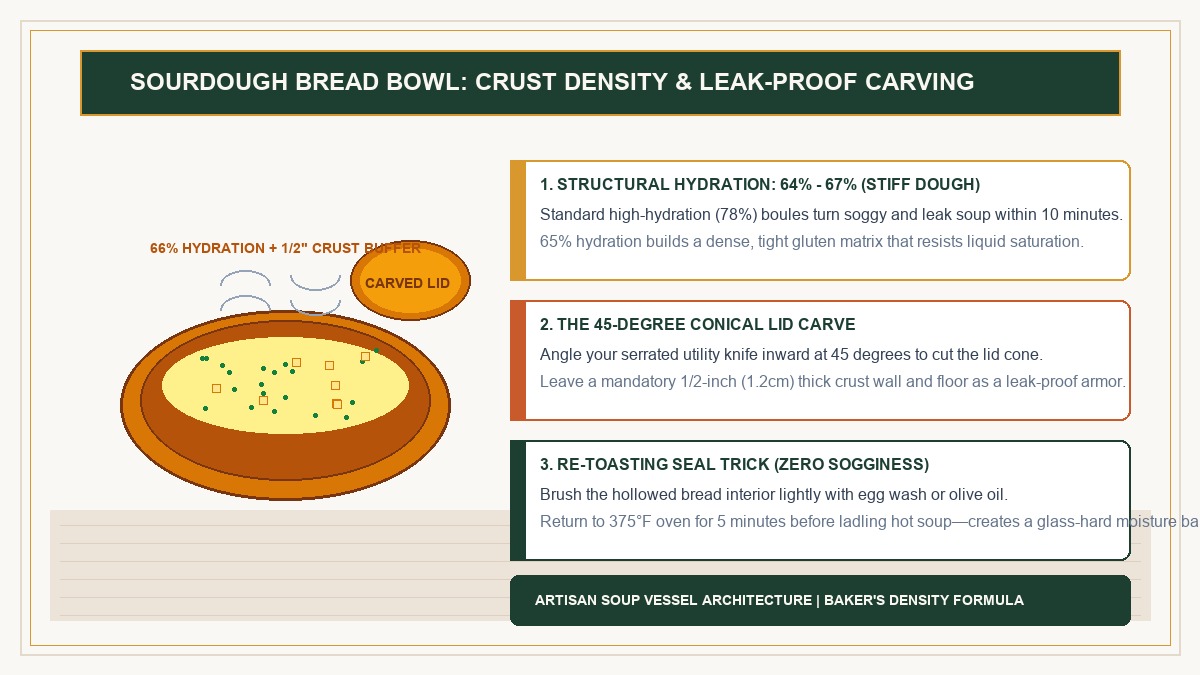
From the fog-drenched piers of San Francisco's Fisherman's Wharf to cozy Wisconsin winter kitchens, few dining experiences rival a steaming, creamy bowl of clam chowder, rich beef chili, or French onion soup served inside a crackling, hollowed artisan sourdough boule. The tangy wild fermentation of sourdough provides the ideal flavor counterpoint, cutting effortlessly through heavy cream, melted gruyère, and unctuous braised meats.
However, turning bread into an edible liquid container is an engineering challenge. When bakers attempt to use standard high-hydration sourdough formulas, the bread bowl inevitably fails: hot broth seeps through large crumb holes, saturates the floor, and leaks all over the plate within five minutes. Baking a true leak-proof bread bowl requires recalibrating structural baker's percentages, building intense surface tension, and executing precision conical carving.
The Science: Standard Open Crumb vs. Structural Bread Bowls
In traditional artisan sourdough boules baked in a Dutch oven, bakers strive for maximum hydration (75% to 85%) to produce an open, irregular, honeycomb crumb with large air pockets. For a soup vessel, this open crumb is fatal:
| Bread Type | Target Hydration | Crumb Morphology | Liquid Retention |
|---|---|---|---|
| Artisan Boule (Open Crumb) | 75% - 82% | Large cavernous pockets; thin cell walls | Fails: Soup channels through holes; leaks within 5 minutes |
| Commercial Bread Bowl | 60% - 62% | Very tight, dry crumb conditioned with chemical emulsifiers | Holds liquid, but lacks artisan flavor, crust crunch, and wild yeast tang |
| Artisan Structural Bowl (Our Formula) | 64% - 66% | Tight, uniform micro-alveoli; thick rigid 1/2" crust shell | Optimal (45+ Minutes): Zero leaking, blistered ear crust, deep sourdough flavor |
Gluten Tension and Dough Weight: To support 16 ounces of heavy liquid without sagging, the dough must be scaled to 260g to 280g per bowl. Cupping the dough ball with both hands against an un-floured wooden bench during shaping builds a taut outer gluten skin that bakes into an impenetrable structural shell. If you need to scale dough quantities, use our interactive sourdough calculator.
The Master Sourdough Bread Bowl Formula (Batch of 4 Bowls)
This formula yields four individual 6-inch soup bowls scaled to 275g each:
📐 Master Structural Sourdough Formula:
- Unbleached Bread Flour (12.7%+ protein): 600g (100%)
- Filtered Water (72°F / 22°C): 378g (63.0% net water)
- Active Mature Sourdough Starter (100% hydration): 120g (20% — contains 60g flour + 60g water)
- Fine Sea Salt: 12g (2.0%)
- Extra Virgin Olive Oil: 12g (2.0% — provides elasticity to prevent tears under liquid pressure)
- Total Flour: 660g | Total Water: 438g | Net Hydration: 66.3%
Step-by-Step Production & Steam Baking Protocol
- Autolyse & Mix: Combine flour, water, starter, and olive oil in a bowl. Rest 30 minutes. Add fine sea salt and knead for 5 minutes until smooth and elastic.
- Bulk Fermentation with 3 Stretch-and-Folds: Let ferment at 76°F (24°C) for 4 to 5 hours. Perform three sets of stretch-and-folds spaced 45 minutes apart during the first 2 hours. Dough should expand by approximately 60% with rounded domed edges. Review our bulk fermentation temperature chart for timing.
- Divide and Pre-Shape: Turn dough out onto a lightly floured surface. Divide into 4 equal pieces (approx 275g each). Pre-shape into round loose balls. Rest 15 minutes bench rest.
- Final Shaping for Maximum Surface Tension: Pull outer edges inward to form a tight seam. Flip boule seam-side down. Place both palms around the base and drag the dough firmly toward your body across an un-floured wooden counter. The friction will pull the top gluten skin taut. Repeat 3 times until the ball is spherical and rigid.
- Proof on Parchment: Place shaped boules on a parchment-lined baking sheet dusted with coarse semolina or cornmeal. Cover with a damp linen towel and proof for 1.5 to 2 hours at room temperature (or cold-retard overnight in the refrigerator for deep sour tang).
- Bake with Steam: Preheat oven with a baking stone or heavy steel to 450°F (232°C), with a cast iron skillet on the bottom rack. Dust boules lightly with flour and score a decorative cross (+) on top with a razor blade. Slide parchment onto the stone and pour 1 cup of boiling water into the hot skillet to generate steam. Bake for 20 minutes with steam, then remove water pan, reduce heat to 400°F (205°C), and bake for another 15 minutes until dark golden brown with a hollow thud when tapped.
- Complete Cool: Cool completely on wire racks for at least 2 hours before carving.
The Carving Physics: 45-Degree Conical Cut & The Toast Barrier
Carving a bread bowl is not haphazard scooping; it is structural sculpting:
- The 45-Degree Inward Bevel: Insert the tip of a small, sharp serrated utility knife approximately 1/2 inch (1.2cm) inward from the outer crust edge. Cut in a circle with the knife angled 45 degrees inward toward the center. This creates a conical lid that pops out cleanly while keeping the upper rim wide and the lower walls thick.
- The 1/2-Inch Wall Buffer: Use your fingers (not a knife or spoon) to gently hollow out the interior crumb in large bite-sized chunks. Always leave at least 1/2 inch of soft crumb lining the bottom floor and sidewalls. If you scrape down to the outer crust, the shell will become brittle and leak.
- The Flash-Toast Moisture Seal: To make your bread bowl 100% impervious to hot broth, brush the interior cavity lightly with beaten egg white or extra virgin olive oil. Place the hollowed bowls back onto a baking sheet and toast at 375°F (190°C) for 5 to 7 minutes. The heat gelatinizes surface starch and coagulates egg proteins, creating an edible, watertight enamel that holds piping-hot clam chowder or chili for an hour!
Frequently Asked Questions (People Also Ask)
What do you do with the carved-out bread interior?
Never throw the carved bread away! Cut the removed interior crumb and lid into bite-sized cubes. Toss with olive oil, garlic powder, and fresh thyme, and bake alongside the bowls for 8 minutes to make dipping croutons. Alternatively, dry the cubes completely to make our famous artisan sourdough holiday stuffing!
Can you make bread bowls ahead of time and freeze them?
Yes! Bread bowls freeze exceptionally well. Bake the boules fully, let them cool completely, but do not carve them before freezing. Wrap each whole boule tightly in plastic wrap and foil, then freeze for up to 3 months. To use, thaw at room temperature for 3 hours, crisp in a 350°F oven for 8 minutes, cool, and carve fresh.
Can I bake bread bowls in a Dutch oven?
Yes, if you have a wide 6-to-7 quart Dutch oven, you can bake two bread bowls at a time with the lid on for 15 minutes, then uncover for 15 minutes. The trapped steam promotes blistered, crunchy ears and deep oven spring. Check out our Dutch oven sourdough science guide for steam mechanics.
What soups work best inside a sourdough bread bowl?
Thick, high-viscosity soups with rich dairy or starch bases work best: New England clam chowder, roasted butternut squash soup, broccoli cheddar soup, thick beef and bean chili, and creamy potato leek soup. Avoid thin, watery broths (like clear chicken noodle), which can saturate bread walls faster.
Explore More Artisan Sourdough Architecture:
From soup vessels to morning breakfast bakes, discover the full spectrum of sourdough physics:
- Visit the comprehensive Artisan Sourdough Pillar Guide.
- Master breakfast griddle baking with our Sourdough English Muffins Guide.
- Bake chewy bagels with our Sourdough Discard Bagels Protocol.