Fermenting Hot Peppers: Whole Pods, Mash Ratios & Hot Sauce pH Science
Most commercial hot sauces found on supermarket shelves are simple concoctions: raw chili peppers pureed with cheap distilled white vinegar and salt. While fiery, they have a sharp, one-dimensional, chemical burn that masks the natural terroir and fruitiness of the pepper. In contrast, legendary sauces—from Avery Island's oak-aged Tabasco to artisan craft hot sauces—derive their soulful complexity from microbial lacto-fermentation.
When fresh chili peppers are submerged in an anaerobic saline environment, indigenous lactic acid bacteria (primarily Leuconostoc mesenteroides and Lactobacillus plantarum) consume natural plant fructose and glucose, producing clean lactic acid, carbon dioxide, and hundreds of complex aromatic esters. The harsh, searing edge of raw capsaicin is transformed into a harmonious, mouthwatering, umami-rich condiment.
The Great Dilemma: Whole Pod Brine vs. Blended Pepper Mash
When preparing to ferment chilis, the very first decision dictates your equipment and risk profile:
| Method | Preparation | Salinity Metric | Risk Profile & Best For |
|---|---|---|---|
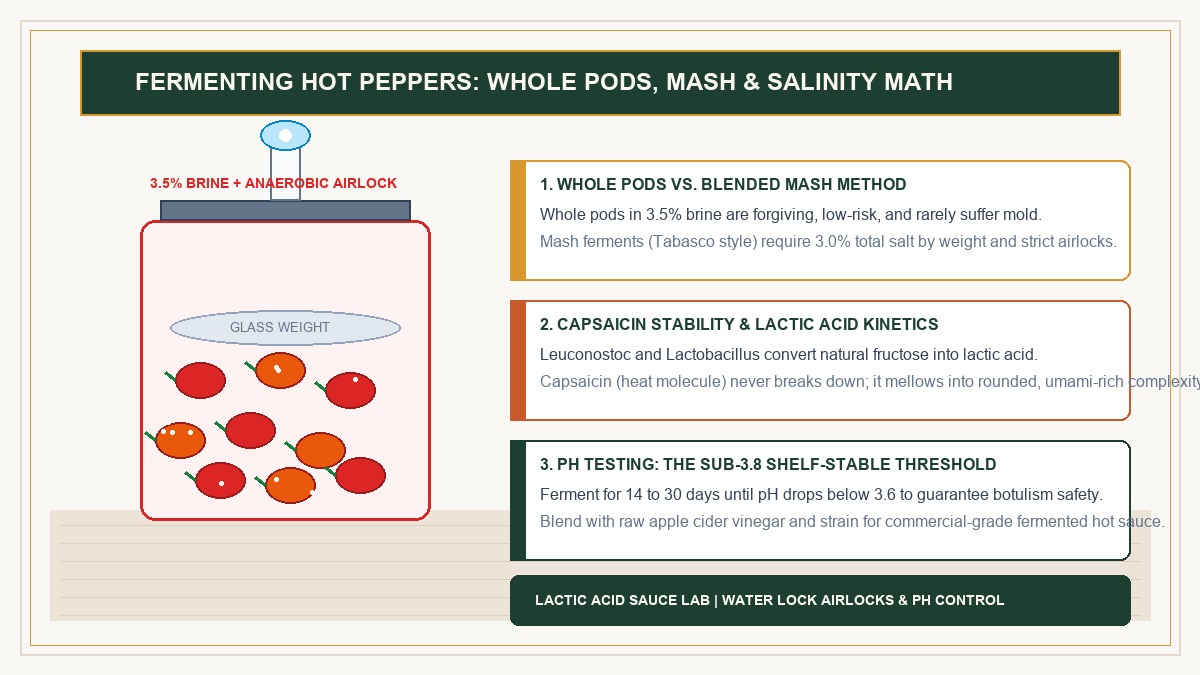
| Whole / Halved Pod Brining | Peppers kept whole or halved; submerged in liquid salt brine | 3.5% Salinity (35g salt per 1L water) | Beginners & High-Yield: Virtually foolproof; glass weights hold solid pods under liquid, preventing mold. |
| Blended Pepper Mash (Tabasco Style) | Peppers, aromatics, and salt pureed into a thick slurry | 3.0% Salt by Weight of total pepper mass | Advanced Pitmasters: Maximizes surface area for rapid fermentation and deeper funky esters; strictly requires airtight airlock. |
For home fermenters seeking repeatable success, the whole or halved pod brine method is overwhelmingly recommended. In mash ferments, tiny flecks of pepper float to the surface, where exposure to trapped oxygen invites white Kahm yeast or fuzzy mold. With whole pods, a simple glass fermentation weight keeps 100% of the solid matter safely submerged below the protective brine line. If you are comparing vessels for vegetable ferments, review our fermentation crocks vs jars guide.
The Chemistry of Salinity & Capsaicin Stability
Unlike cucumbers or cabbage which have high water content and thin cell walls, chili pepper skins are fortified with a tough waxy cuticle. Furthermore, pepper seeds and flesh contain significant natural sugars that surface yeasts love to consume:
- Why 3.5% Salinity Is the Sweet Spot: While sauerkraut thrives at 2.0% to 2.2% salt, peppers require a slightly higher osmotic barrier (3.0% to 3.5%). This suppresses unwanted pectin-degrading enzymes (which cause mushiness) while permitting halotolerant Lactobacillus to flourish.
- Capsaicin Preservation: Capsaicin ($C_{18}H_{27}NO_3$) is a remarkably stable hydrophobic alkaloid. Fermentation does not diminish the absolute Scoville Heat Units (SHU) of your peppers. Instead, the drop in pH and accumulation of lactic acid alters receptor binding on the human tongue, converting an aggressive front-of-mouth sting into a rich, blooming warmth.
The Master Fermented Chili Formula (1-Quart Mason Jar)
📐 Master Fermented Hot Pepper Ingredients:
- Fresh Hot Chilis (Habanero, Jalapeño, Fresno, or Cayenne): 400g to 500g
- Unchlorinated Filtered Water: 500ml / 500g (100% water base)
- Fine Non-Iodized Sea Salt: 17.5g (3.5% salinity by water weight)
- Fresh Garlic Cloves (peeled & smashed): 4 cloves (adds sulfur compounds that convert into umami)
- Yellow Onion or Carrot (optional): 50g (adds natural sugars to accelerate acid production)
- Black Peppercorns: 1 teaspoon
*Calculating custom brine metrics? Use our interactive fermentation calculator to dial in exact gram weights.
Step-by-Step Fermentation & Blending Protocol
- Prep with Gloves: Always wear disposable nitrile gloves when prepping hot chilis. Wash peppers thoroughly. Slice off the green stem caps. Cut peppers in half lengthwise (leaving seeds intact for heat and fermentation nutrients).
- Pack the Jar: Drop smashed garlic cloves and peppercorns into the bottom of a clean 1-quart wide-mouth Mason jar. Pack chili halves tightly, pressing them down so they lock together beneath the shoulder of the jar.
- Dissolve & Pour Brine: Whisk 17.5g of non-iodized sea salt into 500ml of room-temperature unchlorinated water until crystal clear. Pour brine over the peppers until they are covered by at least 1 inch of liquid.
- Weight & Airlock: Place a clean glass fermentation weight on top of the peppers to submerge all solid matter. Seal with a 3-piece water airlock or silicone fermenting lid. Review our fermentation weights and equipment guide for safety specifics.
- The 14-to-30 Day Ferment: Store jar in a dark pantry at 68°F to 74°F (20°C–23°C). Within 48 hours, micro-bubbles of $CO_2$ will form and the brine will turn pleasantly cloudy. Let ferment for a minimum of 14 days (or up to 30 days for deep funk).
- Verify pH Safety: Before blending, test the brine using an instant digital pH meter. The reading must be below 3.6 (indicating complete acidification and botulism safety).
- Blend & Emulsify: Strain peppers, reserving the fermented brine. Transfer peppers and garlic to a high-speed blender. Add 1/2 cup of raw unpasteurized apple cider vinegar and 1/4 cup of the reserved brine. Blend on high for 2 minutes until silky smooth. For commercial restaurant consistency that never separates in the bottle, blend in 1/8 teaspoon of xanthan gum during the final 30 seconds. Bottle in clean glass woozy bottles!
Frequently Asked Questions (People Also Ask)
Why should I add vinegar to a fermented hot sauce?
While lactic acid bacteria produce plenty of acid, adding raw apple cider vinegar serves two purposes: 1) It drops the pH further into the ultra-safe 3.2 to 3.4 range for indefinite shelf life, and 2) Acetic acid provides a bright, sharp top note that complements the deep, earthy, fermented funk of lactic acid.
Will fermented hot sauce explode in the bottle?
If you bottle a live fermented sauce that contains residual unfermented sugars, active bacteria can continue generating $CO_2$ gas inside a sealed bottle, building pressure. You have two options: 1) Store the finished sauce in the refrigerator to induce microbial dormancy, or 2) Gently simmer the blended sauce at 180°F (82°C) for 10 minutes to pasteurize the culture before hot-bottling. If you are carbonating beverages, review our best bottles for kombucha pressure guide.
Can I add fresh fruit like mango or pineapple to the ferment?
Yes! Mango, pineapple, and peaches pair brilliantly with habaneros. However, because tropical fruits are loaded with simple sugars, the fermentation will become very active and produce significant gas. Always use an active airlock. Check out our fermented fruit and lacto plums guide for fruit fermentation kinetics.
What should I do with the leftover fermented pepper brine?
Never pour fermented chili brine down the sink! It is liquid gold packed with live probiotics, spicy capsaicin, and lactic acid. Use it as a spicy marinade for grilled chicken, splash it into bloody marys, stir it into salad dressings, or use it to brine hard-boiled eggs. You can also explore our dedicated fermented hot sauce spoke guide.
Explore More Home Fermentation Science:
From spicy hot sauces to crisp lacto-fermented pickles, explore the full spectrum of probiotic food preservation:
- Visit the comprehensive Lacto-Fermentation Pillar Guide.
- Master garlic preservation with our Fermented Garlic Honey Guide.
- Make snap-crunch pickles with our Lacto-Fermented Gherkins Protocol.