Fermenting Red Onions: Probiotic Crunch & Anthocyanin Color Science
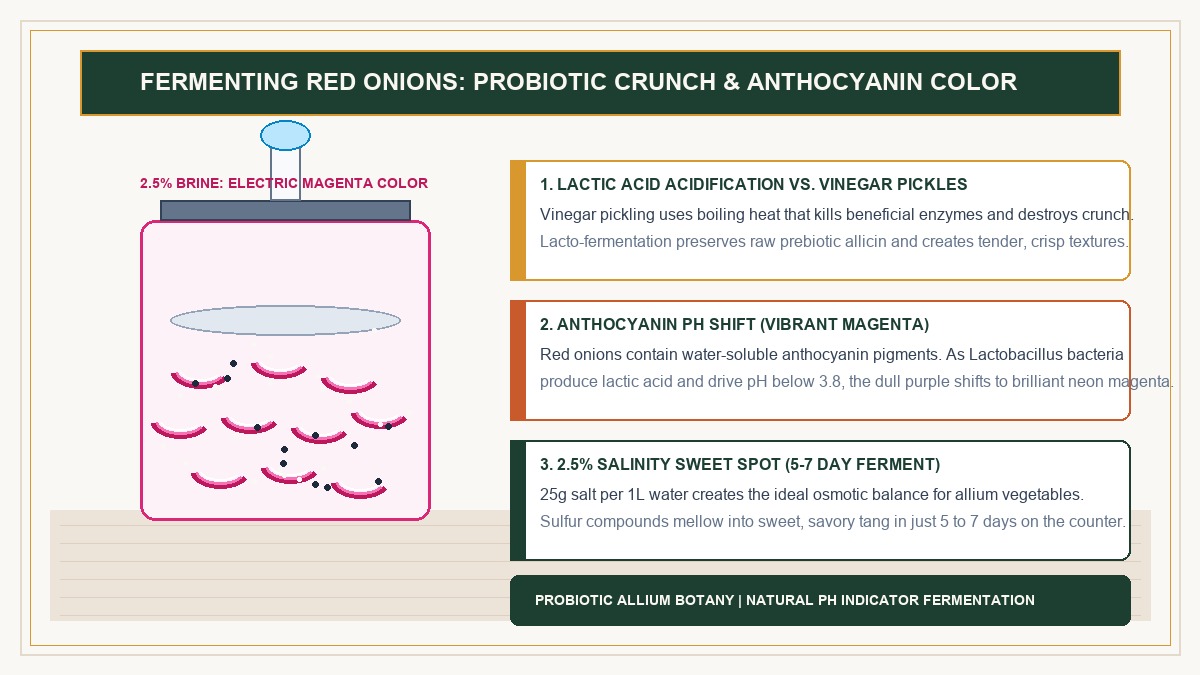
Across taco trucks, barbecue smokehouses, and artisan delis, pickled red onions are a beloved condiment. Their electric pink hue and sharp acidity brighten rich pulled pork, grilled fish tacos, and smoked meats. Yet, 99% of restaurant and home kitchens make them the same shortcut way: pouring boiling distilled vinegar, sugar, and water over raw onions.
While quick-pickling is fast, boiling vinegar kills beneficial food enzymes, cooks the onion into a limp texture, and imparts an aggressive, one-dimensional acetic acid bite. In contrast, lacto-fermenting red onions without vinegar is a revelation. By harnessing wild lactic acid bacteria in a simple 2.5% salt brine, the pungent, crying sulfur compounds of raw allium vegetables mellow into sweet, complex tang, all while preserving crisp snap and creating a live probiotic superfood.
The Science: Anthocyanin Pigments as Natural pH Indicators
One of the most stunning visual phenomena in the kitchen occurs during red onion fermentation: within 48 hours, the dull, dark purple-violet rings transform into a glowing, translucent electric neon magenta. This is not food dye—it is pure plant biochemistry:
| Fermentation Stage | Internal Brine pH | Anthocyanin Molecular Form | Visual Color Profile |
|---|---|---|---|
| Day 0 (Raw Onion) | pH 6.0 - 6.5 (Neutral) | Quinonoidal base (neutral molecule) | Dull purple-violet with white inner flesh |
| Day 2 (Leuconostoc Active) | pH 4.8 - 5.2 (Mild Acid) | Mixed flavylium transition | Rosy pink bleeding into surrounding brine |
| Day 5 (Lactobacillus Dominant) | pH 3.4 - 3.8 (High Acid) | Flavylium cation (stable acidic ion) | Brilliant Neon Magenta: 100% translucent electric pink |
Red onions are packed with anthocyanins (primarily cyanidin 3-glucoside), the same antioxidant pigments found in blackberries and red cabbage. Because anthocyanins act as natural optical pH indicators, their molecular geometry rearranges as lactic acid concentrations climb. When your onions turn bright magenta, you have visual proof that your ferment has acidified into safe, pathogen-free territory! If you are fermenting other antioxidant-rich foods, explore our lacto-fermented plums and fruit guide.
The Slicing Secret: Pole-to-Pole vs. Crosswise Rings
How you slice your onion dictates whether your fermented pickles stay snap-crisp or turn into limp, stringy mush:
- Crosswise Slicing (Avoid): Cutting across the equator severs longitudinal cell walls and ruptures millions of vacuole sacs, releasing cellular water into the brine. The rings lose turgor pressure and turn flaccid within days.
- Pole-to-Pole Slicing (The Master Technique): Cut the onion in half from root to stem. Place cut-side down, slice off the stem, and cut thinly along the grain (from pole to pole) into 1/8-inch (3mm) crescents. This keeps the cellulose fiber scaffolding intact, ensuring each crescent retains a clean, audible snap when bitten.
The Master Fermented Red Onion Formula (1-Quart Mason Jar)
📐 Master Fermented Red Onion Ingredients:
- Fresh Firm Red Onions: 400g to 450g (approx 2 medium onions — sliced pole-to-pole)
- Unchlorinated Filtered Water: 500ml / 500g (100% water base)
- Fine Non-Iodized Sea Salt: 12.5g (2.5% salinity by water weight)
- Whole Black Peppercorns: 1 teaspoon (cracked)
- Whole Allspice Berries: 4 berries (adds warm aromatic complexity)
- Dried Bay Leaf: 1 leaf (adds natural tannins to support cell crispness)
- Fresh Garlic: 2 cloves (halved — optional for savory depth)
*Scaling for larger fermentation crocks? Use our interactive fermentation calculator to compute exact salt grams.
Step-by-Step Fermentation Protocol
- Prep and Slice: Peel red onions. Cut in half from root to stem. Slice pole-to-pole into uniform 1/8-inch crescents.
- Pack Aromatics and Onions: Place cracked peppercorns, allspice berries, and bay leaf into the bottom of a clean 1-quart wide-mouth Mason jar. Pack the sliced onion crescents tightly into the jar, leaving 1.5 inches of headspace beneath the rim.
- Dissolve & Pour 2.5% Brine: Whisk 12.5g of fine sea salt into 500ml of room-temperature unchlorinated water until completely clear. Pour the saline solution over the onions until fully submerged.
- Submerge with Glass Weight: Onions are buoyant and love to float. Place a clean glass fermentation weight on top of the onions, pressing gently to force all strands below the brine surface. Review our fermentation weights and equipment guide.
- Airlock Seal: Seal jar with a silicone fermentation nipple lid or a 3-piece water airlock to permit carbon dioxide gas to escape without allowing oxygen in.
- The 5-to-7 Day Ferment: Keep jar at 68°F to 74°F (20°C–23°C) out of direct sunlight. By Day 2, tiny carbon dioxide bubbles will rise and the brine will blush pink. By Day 5, taste an onion: it should be pleasantly tart, mildly sweet, crisp, and vivid neon magenta.
- Refrigerate & Enjoy: Once your desired acidity is reached, remove weight, cap with a standard lid, and transfer to the refrigerator. Cold storage halts further acidification, preserving crunch and flavor for up to 6 months!
Frequently Asked Questions (People Also Ask)
Can I add jalapeños or habaneros to the onions?
Yes! Sliced fresh jalapeños or serrano peppers add fantastic heat and pair naturally with red onions for taco night. Simply slice 1 or 2 peppers into rounds and layer them with the onions before pouring the brine. For dedicated pepper ferments, check our fermenting hot peppers guide.
Why does my brine smell slightly sulfurous on Day 2?
Raw onions contain high concentrations of organic sulfur compounds (such as *alliin* and *propanethial S-oxide*). During the first 48 hours of fermentation, initial microbial activity releases these volatile gases, causing a brief pungent sulfur aroma when the airlock vents. By Day 4, lactic acid bacteria completely metabolize and transform these molecules into pleasant, fruity, umami-rich aromatic esters.
Can I reuse the fermented onion brine?
Yes! The leftover magenta brine is seasoned probiotic liquid gold. Splash it into vinaigrettes, drizzle it over potato salad, use it to deglaze sauté pans, or use it as a starter splash for your next batch of lacto-fermented pickles or fermented gherkins!
Do I need to add starter cultures like whey to ferment onions?
No starter cultures are required! Raw red onions naturally harbor millions of beneficial wild *Lactobacillus* bacteria on their skins and outer layers. Providing an unchlorinated, 2.5% saline environment is all that is required for wild lactic fermentation to initiate spontaneously and safely.
Explore More Home Fermentation Science:
From probiotic alliums to fizzy kombucha and crunchy pickles, explore traditional food preservation:
- Visit the comprehensive Lacto-Fermentation Pillar Guide.
- Master garlic preservation with our Fermented Garlic Honey Guide.
- Ensure safe carbonation with our Best Bottles for Kombucha 2F Guide.